Choosing between live-in care and hourly home care is one of the most significant decisions a family can face. There is no universal “right” answer but with the right information, the right answer for your loved one becomes much clearer.
Across the United Kingdom, demand for home-based care is growing faster than ever. More families are recognising that staying at home surrounded by familiar routines, cherished belongings, and loved ones is not just possible with the right support; it is often the best option. At Kuremara, we believe that understanding your choices is the first step to making a confident decision.
This guide walks you through both care models in plain language, what they involve, who they suit best, what they cost in 2025/26, and how to match the right approach to your unique situation.
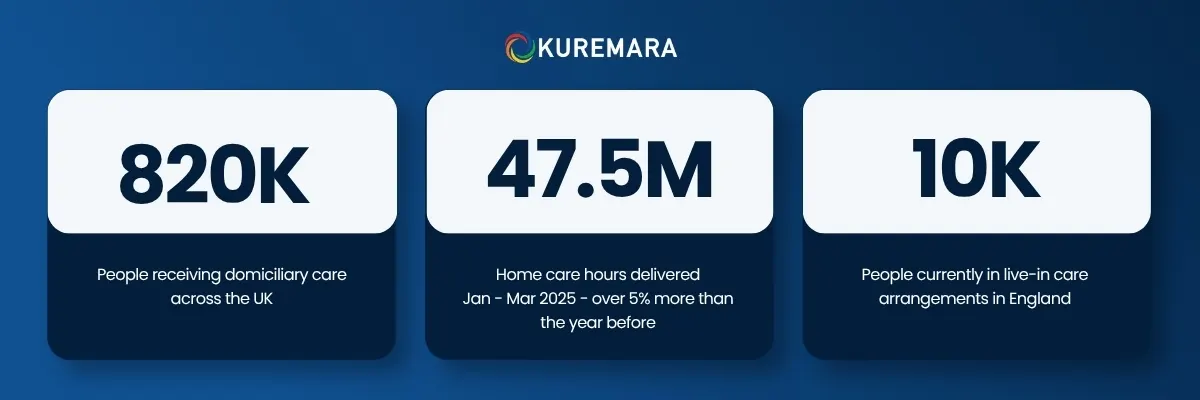
Sources: Homecare Association; CQC State of Care 2024/25; PolicyBee Domiciliary Care Statistics 2025.
What Is Live-In Care?
Live-in care means a professional carer moves into your loved one’s home and provides continuous, round-the-clock support. They become a consistent, trusted presence, someone who understands not just the care needs, but the daily rhythms, preferences, and personality of the person they support.
The carer will typically have their own bedroom within the home and is entitled to rest breaks during the day. Most arrangements involve one primary carer working six days per week, with a relief carer covering the seventh day.
Who benefits most from live-in care?
- People with dementia, Parkinson’s, or other conditions requiring consistent supervision and familiar surroundings
- Those recovering from a stroke or hospital discharge who need intensive, short-term or long-term support
- Individuals with limited mobility who need assistance throughout the day and night
- Couples where one or both partners have care needs a single live-in carer can support both
- Anyone who prioritises continuity of relationship with their carer, rather than rotating visits
- Those experiencing loneliness, where companionship throughout the day is as important as practical help
“One of the most underappreciated benefits of live-in care is what it does for family members. When a dedicated professional is present around the clock, adult children and partners can step back from the carer role and simply be family again.“
— Kuremara Care Advisory Team
What Is Hourly (Domiciliary) Care?
Hourly care, often called visiting care or domiciliary care, involves a professional carer visiting your home at agreed times throughout the day or week. Visits can be as brief as 30 minutes or extend to several hours, depending on what is needed. The service scales with you as needs change, hours can be added or reduced.
This is currently the most widely used form of home care in the UK. According to the Care Quality Commission, there were 499,797 people receiving regulated domiciliary care in England in November 2025, a figure that has been steadily growing each month.
Who benefits most from hourly care?
- Those who are largely independent but need help with specific tasks: bathing, dressing, meal preparation, or medication management
- Individuals with a strong network of family or friends who provide support between visits
- People who value maintaining their autonomy and prefer time at home without a carer present
- Those in the earlier stages of a condition who may not yet need full-time support
- Family carers seeking respite, hourly care can provide regular breaks without disrupting the overall care arrangement
- Anyone easing gradually into professional care, where trust and routine can be built over time
Side-by-Side: Key Differences at a Glance
Understanding the Costs in 2025/26
Cost is, understandably, one of the first questions families ask. Below is an honest overview of what you can expect to pay along with the context that often gets left out of simpler comparisons.
Many families are surprised to find that live-in care can be comparable in cost, or even more affordable than a residential care home. In England, care home fees currently range from approximately £800 per week for residential care to £1,100 for nursing care, with dementia care averaging £950 per week. Live-in care typically starts at £1,200 per week but offers one-to-one attention that care homes simply cannot match. For couples, live-in care is often significantly more cost-effective.
Sources: Homecare Association 2025/26; DHSC; Sylvian Care Cost Comparison 2025
Funding options available in the UK
Neither live-in nor hourly care needs to be funded entirely out of pocket. The following support mechanisms are worth exploring:
- Local Authority Funding: If savings and assets fall below £23,250 in England, your local council may contribute toward care costs following a needs and financial assessment.
- NHS Continuing Healthcare (CHC): Individuals with a primary health need may qualify for fully funded care in any setting, including at home, assessed by a multidisciplinary team.
- Attendance Allowance: A non-means-tested benefit of up to £108.55 per week (2025/26 higher rate) for those over State Pension age with care needs.
- Personal Independence Payment (PIP): Available to those under State Pension age with care or mobility needs resulting from illness or disability.
- Carer’s Allowance: £83.30 per week (2025/26) for family members providing 35+ hours of care per week.
- Equity Release: For homeowners, releasing equity can help fund care though independent financial advice is strongly recommended before proceeding.
Agency Care vs. Hiring a Private Carer
Once you have decided on the care model, a second choice arises: should you arrange care through a regulated agency, or hire a private carer directly? Both routes have merit, but they come with very different responsibilities.
What a regulated agency provides
- All carers are fully DBS-checked, referenced, and hold relevant qualifications
- Oversight from the Care Quality Commission (CQC), the independent regulator of health and social care in England
- Cover arrangements if your regular carer is unwell or on holiday
- Employer obligations (payroll, National Insurance, holiday pay, pensions) are handled on your behalf
- A formal complaints procedure and access to regulatory escalation if needed
- Ongoing training and professional development for care staff
Considerations when hiring privately
Hiring an independent carer directly may reduce costs, since agency fees are removed. However, you become the legal employer responsible for contracts, minimum wage compliance, sick pay, holiday pay, employer’s liability insurance, and tax. You must also arrange cover if your carer is unavailable, and there is no external oversight of the care being provided.
For families with experience managing care arrangements, this can work well. For most, the safeguards and accountability of a regulated agency represent the safer and simpler choice.
A Note on Dementia and Specialist Conditions
For the estimated 900,000 people living with dementia in the UK, a figure projected to rise to 1.6 million by 2040; the care environment matters enormously. Research consistently shows that familiar surroundings reduce confusion and anxiety, support memory recall, and help maintain a sense of self.
Live-in care is particularly well-suited to dementia, Parkinson’s disease, post-stroke recovery, and end-of-life care precisely because it delivers consistency: the same carer, the same routines, the same home. Hourly care can be appropriate in the earlier stages, or where specialist visits (physiotherapy, nursing) complement wider family support.
At Kuremara, all of our care plans for specialist conditions begin with a comprehensive needs assessment, ensuring that the type and level of care recommended genuinely matches the individual not a template.
How to Choose: A Practical Framework
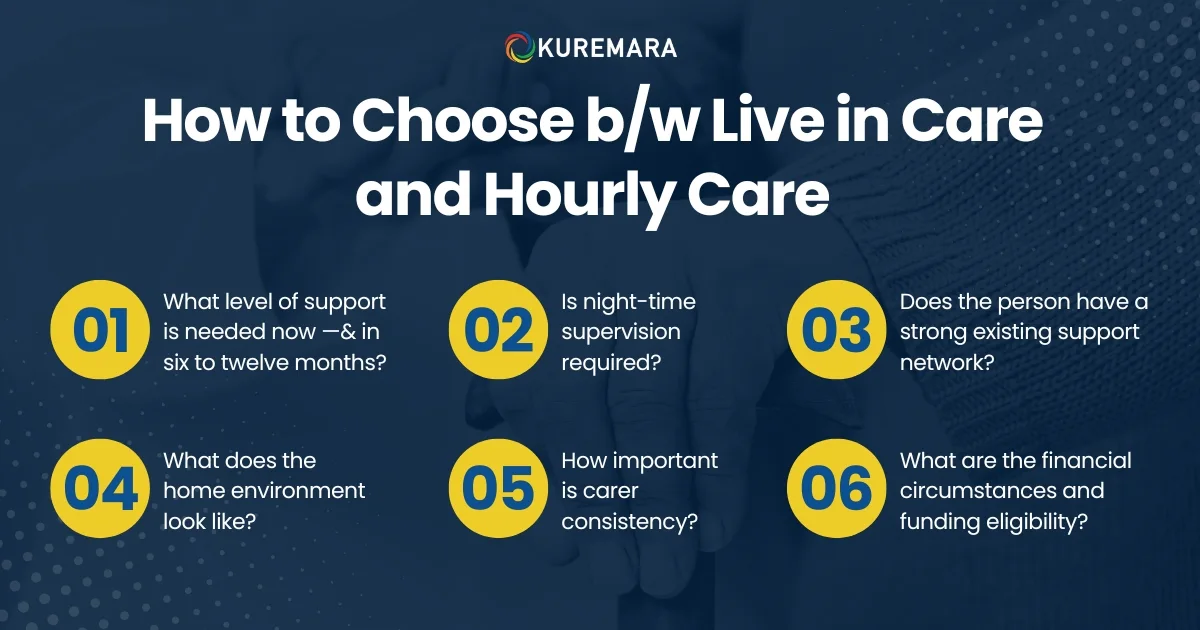
There is no single formula, but the following questions can help you arrive at a clear direction:
- What level of support is needed now — and in six to twelve months? Anticipating changing needs prevents disruptive transitions.
- Is night-time supervision required? If so, live-in care or waking night visits should be factored into the plan.
- Does the person have a strong existing support network? Family and friends who provide daily contact may make hourly care a more practical fit.
- What does the home environment look like? A spare bedroom and appropriate facilities are required for a live-in arrangement.
- How important is carer consistency? Some individuals thrive with a familiar face; others adapt well to a rotating team.
- What are the financial circumstances and funding eligibility? A care funding assessment is often a sensible first step before committing to either option.
Not Sure Where to Start? We’re Here to Help.
Live-in care and hourly care both offer meaningful ways to support independent living at home. The difference lies in the level of presence, flexibility, reassurance, and continuity each one provides.
Hourly care may be ideal for those who need support at specific times and are otherwise confident managing at home. Live-in care may be the better choice when support is needed more regularly, when companionship is essential, or when safety and peace of mind are a greater concern.
For many families, this decision is about much more than care alone. It is about protecting quality of life, maintaining familiar routines, and making sure support feels personal rather than disruptive.
At Kuremara, we are committed to helping individuals and families navigate these choices with clarity, compassion, and confidence. When care is tailored to the person, home can continue to be the place where life feels most comfortable, secure, and truly their own.