Choosing a home care agency is a decision that can shape everyday comfort, safety, and peace of mind. A warm first impression matters, but it should never be the only reason to move forward. Before you sign any agreement, it is worth asking careful, practical questions about how the agency recruits staff, trains carers, plans care, manages emergencies, communicates with families, and explains its pricing.
For families in the United Kingdom, due diligence is not about being difficult. It is about making sure the agency has the right systems behind the promises. The strongest providers are usually happy to answer detailed questions clearly and in writing.
This guide from Kuremara is focused strictly on choosing a home care agency. It does not cover role definitions or care funding rules. Instead, it gives you a practical checklist to help you compare providers with confidence.
Why You Need a Proper Agency Checklist
A brochure may look polished. A phone call may sound reassuring. But the real test of a home care agency is how well it operates when everyday care needs change, a regular carer is unavailable, a concern is raised, or a family needs clear answers quickly.
A good checklist helps you look past marketing language and focus on how the agency actually works. It also gives you a fair way to compare one provider against another.
The Mandatory Home Care Agency Checklist: 17 Questions to Ask Before You Sign Up
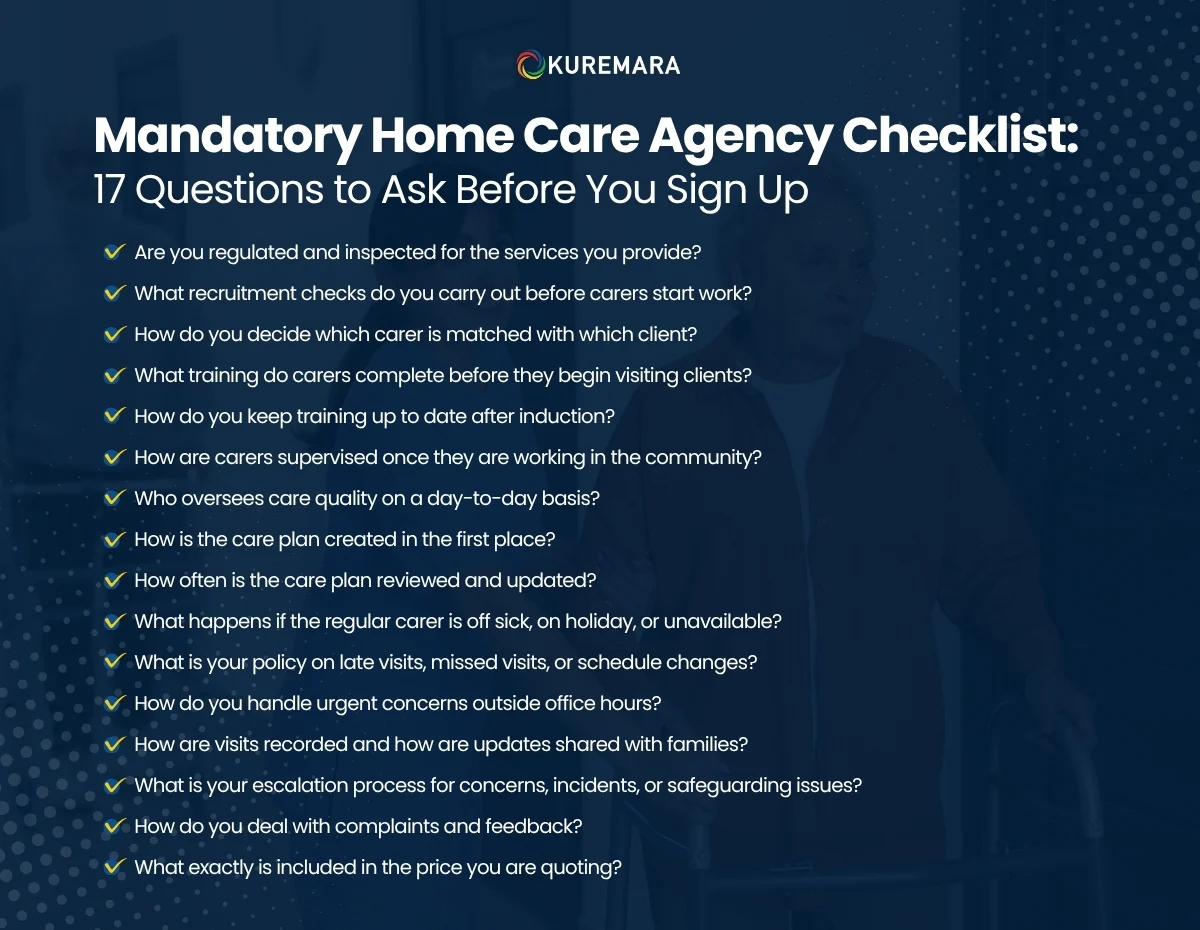
1. Are you regulated and inspected for the services you provide?
Start with the basics. Ask whether the agency is properly regulated for the care services it offers in your area of the UK. Regulation does not guarantee that every experience will be perfect, but it does help you confirm that the provider is operating within the right framework and has been assessed against recognised standards.
You should also ask how recently the agency was inspected and whether there are any action plans or service improvements currently underway. A trustworthy agency should be open about its status and willing to explain what it is doing well and where it is improving.
2. What recruitment checks do you carry out before carers start work?
This is one of the most important questions in the entire process. Ask exactly what checks are carried out before a carer is sent into someone’s home. A well-run agency should have a clear safer recruitment process rather than a vague answer about “checking everyone properly”.
Look for detail around employment history, references, identity checks, right-to-work checks, and criminal record screening where relevant. Families should feel confident that the agency takes recruitment seriously and does not rush people into care delivery simply to fill gaps.
3. How do you decide which carer is matched with which client?
Good care is not only about availability. It is also about fit. Ask how the agency matches carers to the person receiving support. The answer should go beyond timing and location.
A thoughtful matching process may consider personality, communication style, language, preferences, routines, cultural understanding, and experience with similar care needs. When the match is right, care often feels more comfortable, more consistent, and less stressful for everyone involved.
4. What training do carers complete before they begin visiting clients?
Do not settle for a general statement such as “all our carers are fully trained”. Ask what that training actually includes. A strong provider should be able to explain the induction process clearly and show that carers are prepared before they begin working alone.
This question helps you understand whether the agency values readiness or simply assumes that experience is enough. Initial training should cover both practical care standards and the importance of respectful, person-centred support in the home.
5. How do you keep training up to date after induction?
Training should not stop once a carer starts work. Ask how the agency keeps knowledge current and how refresher training is managed. This matters because needs can change over time, and carers may need additional learning to support people safely and confidently.
An agency that invests in ongoing development is more likely to maintain standards, adapt to changing needs, and support staff properly in the long term.
6. How are carers supervised once they are working in the community?
Home care often takes place behind closed doors, so supervision matters. Ask how the agency monitors quality once a carer is out in the field. You want to know whether staff are regularly observed, reviewed, and supported rather than left to work without oversight.
Strong supervision helps agencies identify concerns early, reinforce good practice, and maintain accountability. It also shows that quality is managed actively, not assumed.
7. Who oversees care quality on a day-to-day basis?
Families often speak first to a friendly coordinator or adviser, but it is important to know who actually takes responsibility for care quality. Ask who manages service delivery day to day, who reviews issues, and who makes decisions when concerns arise.
A clear answer shows that the agency has structure. A vague answer may suggest blurred accountability, and that can become a serious problem if a missed visit, complaint, or safeguarding concern occurs later.
8. How is the care plan created in the first place?
Care should never begin with assumptions. Ask how the agency gathers information before support starts and how the care plan is developed. A good process should include a proper assessment, discussion with the individual and family where appropriate, and a clear understanding of routines, preferences, risks, and outcomes.
This question matters because a weak or generic care plan often leads to inconsistent support. A personalised plan creates the foundation for better visits and better communication.
9. How often is the care plan reviewed and updated?
Needs change. Routines change. Health conditions change. Ask how often the agency reviews care plans and what happens when new needs emerge between formal reviews.
You want a provider that updates support in a timely way rather than waiting for a scheduled date while problems build. Responsive care planning is often one of the clearest signs that an agency is organised and attentive.
10. What happens if the regular carer is off sick, on holiday, or unavailable?
This question is essential. Even agencies with good continuity arrangements need a realistic backup plan. Ask exactly how cover is arranged when the usual carer cannot attend and whether replacement carers are briefed in advance.
Families should not have to discover the backup system only when something goes wrong. A dependable agency should be able to explain how it handles staff absence, urgent cover, and continuity of care without creating confusion for the client.
11. What is your policy on late visits, missed visits, or schedule changes?
Care at home often depends on timing. Medication, meals, washing, routines, and emotional reassurance can all be affected by delays. Ask what happens if a visit is running late or cannot be completed as planned.
A strong answer should include how the agency informs the client or family, who takes responsibility for resolving the issue, and how recurring problems are escalated. Clear systems here can prevent stress and protect trust.
12. How do you handle urgent concerns outside office hours?
Not every problem happens between nine and five. Ask whether the agency has out-of-hours support and what families should do if there is a late-night issue, weekend concern, or emergency change.
An agency that provides care in people’s homes should be prepared for real-life situations, not just routine administration. The answer should make it clear that there is a reliable route for urgent contact and decision-making beyond normal office times.
13. How are visits recorded and how are updates shared with families?
Transparency matters. Ask how the agency records completed visits, changes in condition, and day-to-day notes. Also ask how families can stay informed, especially if they are not present at every visit.
Good communication systems help reduce misunderstandings and allow concerns to be spotted sooner. They also show that the provider takes documentation seriously rather than relying on memory or informal updates.
14. What is your escalation process for concerns, incidents, or safeguarding issues?
This is another critical due-diligence question. Ask what happens if a serious concern arises. You need to know how the agency responds, who is informed, how incidents are reviewed, and how families are kept updated when appropriate.
A confident, structured answer usually signals that safety is treated as a core responsibility. A hesitant or overly casual response may suggest the opposite.
15. How do you deal with complaints and feedback?
No service is perfect all the time. The real question is how the agency responds when something is not right. Ask whether there is a formal complaints process, how complaints can be made, who investigates them, and how quickly families should expect a response.
You should also ask how the agency uses feedback more broadly. Well-run providers usually see complaints and comments as opportunities to improve rather than as threats to dismiss.
16. What exactly is included in the price you are quoting?
Price transparency is vital. Ask for a clear breakdown of what is included, what is charged separately, whether there are minimum visit lengths, and whether rates differ for evenings, weekends, bank holidays, or short-notice changes.
This question protects families from unpleasant surprises later. A reliable agency should be able to explain costs in plain English and provide written clarity rather than relying on verbal estimates alone.
17. What are the contract terms, notice periods, and cancellation rules?
Before signing anything, ask what happens if you want to pause, change, or end the service. Find out how much notice is required, whether there are any setup fees, whether charges continue during short breaks, and what happens if the agency cannot meet agreed expectations.
This final question matters because problems often arise in the small print rather than the sales conversation. Clear contract terms help families make informed decisions and avoid feeling trapped later.
How to Use This Checklist Properly
Use these 17 questions with every agency you are considering. Take notes during calls or meetings. Ask for important points in writing, especially around pricing, contract terms, backup cover, and complaints procedures.
The goal is not to find a provider that says all the right things. The goal is to find one that can explain its systems clearly, consistently, and confidently. In most cases, that tells you far more than polished marketing language ever will.
A Smarter Way to Compare Agencies
When comparing providers, it helps to look at three things together:
First, consider clarity. Did the agency answer your questions directly, or did it rely on broad claims and sales language?
Second, consider consistency. Did the information stay the same across emails, calls, and written documents?
Third, consider confidence. Did the team sound organised and accountable, or unsure and reactive?
The best agency is not always the one with the lowest quote. It is often the one with the strongest systems, the clearest communication, and the best fit for the person receiving care.
Other Useful Checklists in One Place
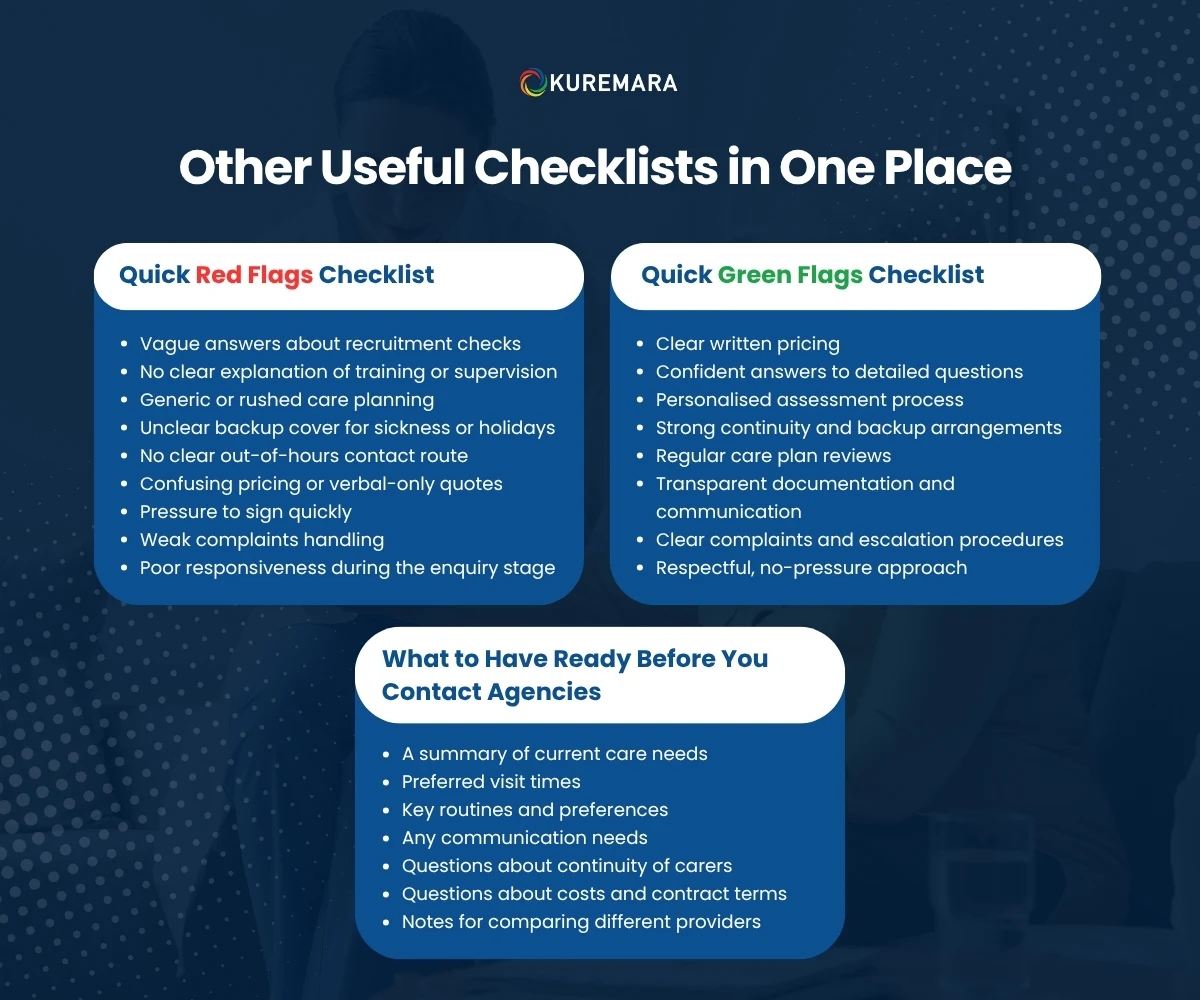
Quick Red Flags Checklist
- Vague answers about recruitment checks
- No clear explanation of training or supervision
- Generic or rushed care planning
- Unclear backup cover for sickness or holidays
- No clear out-of-hours contact route
- Confusing pricing or verbal-only quotes
- Pressure to sign quickly
- Weak complaints handling
- Poor responsiveness during the enquiry stage
Quick Green Flags Checklist
- Clear written pricing
- Confident answers to detailed questions
- Personalised assessment process
- Strong continuity and backup arrangements
- Regular care plan reviews
- Transparent documentation and communication
- Clear complaints and escalation procedures
- Respectful, no-pressure approach
What to Have Ready Before You Contact Agencies
- A summary of current care needs
- Preferred visit times
- Key routines and preferences
- Any communication needs
- Questions about continuity of carers
- Questions about costs and contract terms
- Notes for comparing different providers
Conclusion
Choosing a home care agency should never feel like a leap in the dark. The right questions can help you move beyond first impressions and understand how the service is likely to work in real life. Recruitment checks, staff training, supervision, care planning, backup cover, escalation policies, and price transparency are not minor details. They are the foundations of dependable care.
At Kuremara, we believe informed decisions lead to safer, steadier, and more reassuring care arrangements. Before you sign up with any home care agency, use this checklist, compare answers carefully, and make sure the provider can show you not only what it promises, but how it delivers.