If you are reading this, you are likely standing at a crossroads. Perhaps a parent has had a fall, or a partner’s needs have suddenly increased, and the phrase “care home” has moved from a distant possibility to an immediate conversation.
Finding the right care is emotional enough without the added stress of deciphering who pays for what. A common misconception is that because we have the NHS, social care is also free. In reality, while the NHS is free at the point of use, social care in the UK is means-tested. This means most families will have to contribute something toward the costs.
This guide breaks down the high-level funding rules for 2026–27, helping you understand where you stand before you sign any contracts.
Key Takeaway: You should never discuss finances until you have agreed on the care needed. Always secure a Needs Assessment first.
How Care Home Funding Works in the UK
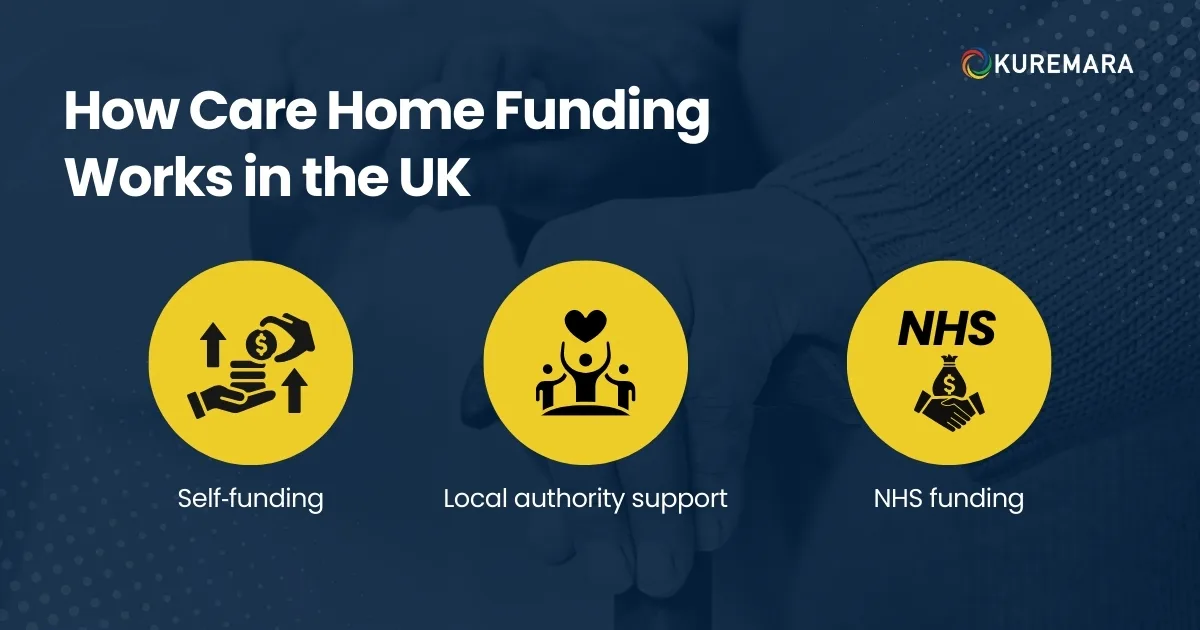
Funding care isn’t one-size-fits-all, and most families end up using a combination of the routes below rather than just one. Broadly, here are the ways a care home place gets paid for in the UK:
- Self-funding: You cover the full cost yourself. If capital (savings, investments and, for a permanent residential move, usually your property) sits above the upper limit, this will be your starting point.
- Local authority support: If your capital falls below the set limits, your council may contribute — but only after a Needs Assessment and a Financial Assessment (the “means test”).
- NHS Continuing Healthcare (CHC): If your needs are primarily health-related rather than social, the NHS may fund 100% of your care. It is not means-tested.
- NHS-funded Nursing Care (FNC): If you’re in a nursing home and need registered nursing but don’t qualify for full CHC, the NHS pays a flat weekly contribution toward the nursing element.
- Deferred Payment Agreement (DPA): A formal arrangement with your council that lets you delay paying care fees from your property’s value — the council places a legal charge on the home and is repaid later (usually when it’s sold or from your estate). It stops you being forced into a rushed sale.
- Top-up (third-party) fees: If you choose a home that costs more than the council’s agreed rate, a third party — typically a relative — pays the difference.
- Other private routes: Some families use a care-fee (immediate needs) annuity, equity release, or renting out rather than selling the property. These have significant financial implications and are worth taking independent, regulated advice on before committing.
- Benefits and charitable help: Disability-related benefits (such as Attendance Allowance) and grants from some charities can reduce what you contribute. Always check entitlement before assuming you must pay in full.
Key Assessments Explained
1: The Needs Assessment (The “What”)
Before you worry about bank accounts or property values, you need to establish exactly what kind of support is required. This is done through a Care Needs Assessment carried out by your local authority social services team.
- It is a statutory right: You are entitled to this assessment regardless of how much money you have.
- It is impartial: The social worker will identify if your loved one needs a residential setting or if their needs can be safely met at home (domiciliary care).
- Why it matters: If the local authority agrees that needs can be met at home, they may not fund a care home place even if you qualify financially. Conversely, if you want care at home, this assessment is the evidence you need to support that choice.
2: The Financial Assessment (The “How Much”)
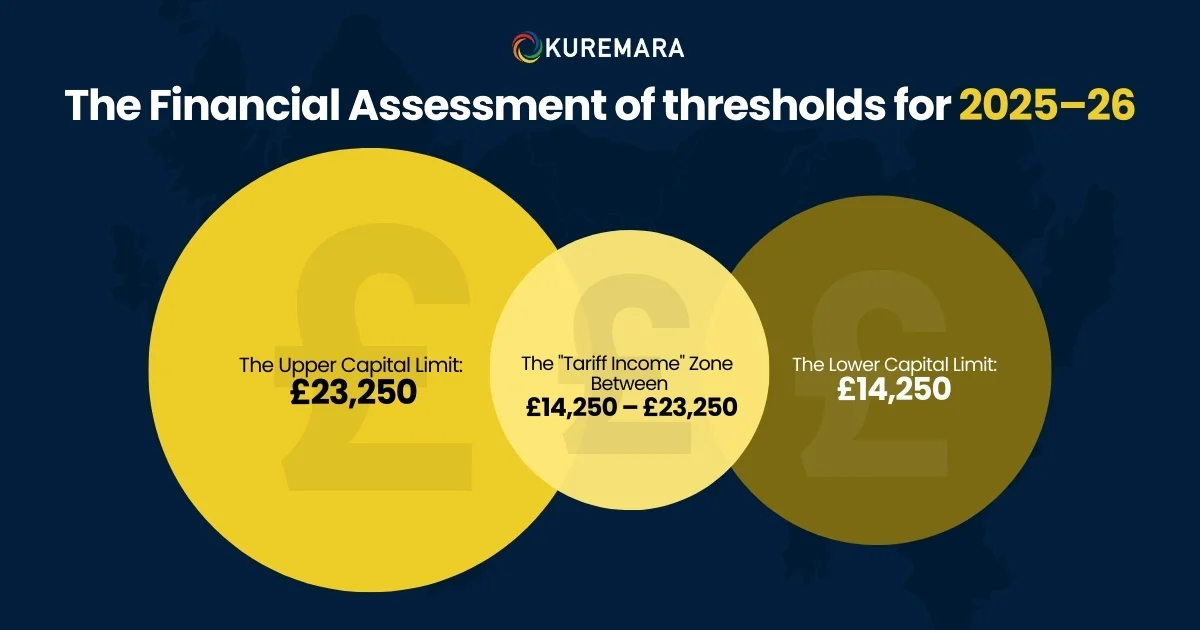
Once needs are agreed upon, the “means test” begins. This is a financial audit of your loved one’s capital (savings, investments, and potentially property) and income (pensions, benefits).
In England, the thresholds for 2026–27 remain fixed at the following levels. These figures determine how much support you can get:
a. The Upper Capital Limit: £23,250
If your loved one has assets above £23,250, they are classed as a “self-funder.”
- They must pay the full cost of their care.
- The “Property” Trap: If they are moving into a residential home permanently, the value of their main home is usually included in this calculation (unless a spouse or dependent still lives there).
b. The Lower Capital Limit: £14,250
If assets are below £14,250, they will receive maximum support from the local authority.
- Note: They will still contribute most of their income (e.g., state pension) toward the fees, keeping only a small “Personal Expenses Allowance” (currently £31.80 per week in England).
c. The “Tariff Income” Zone (Between £14,250 – £23,250)
If assets fall between these two figures, the local authority pays some costs, but the individual must pay a “tariff income”.
- This is calculated as £1 per week for every £250 of capital they have above the lower limit.
Source: nhs.uk
3: When is Care Free? (NHS Support)
Before accepting that you must pay for care, you must ask: Is this a health need?
If your relative’s needs are primarily medical (e.g., complex medication, breathing issues, or terminal illness) rather than social (e.g., washing, dressing), they may qualify for NHS Continuing Healthcare (CHC).
- What it is: A package of care funded 100% by the NHS.
- The Benefit: It is not means-tested. If eligible, the NHS pays for everything: care, accommodation, and food, whether in a nursing home or at home.
The “Consolation Prize”: NHS Funded Nursing Care (FNC)
If you don’t qualify for full CHC but live in a nursing home and need nursing care, the NHS will pay a flat rate directly to the home to cover the nursing portion of the fees.
- 2026–27 Standard Rate (England): The NHS pays £268.68 per week toward the bill. Make sure this is deducted from the fees quoted to you by the care home.
Important Tip
If you’re self‑funding and think your savings might fall below £23,250 soon, contact your council a few months early for reassessment. Funding only applies from the date the council begins your assessment not retrospectively.
NHS Funding: Continuing Healthcare (CHC)
How NHS Continuing Healthcare (CHC) Eligibility Is Decided
CHC is the route many families overlook — research suggests most people have never heard of it, even though it can cover 100% of care costs and is not means-tested. But it is assessed strictly, and understanding how the decision is made is the difference between a successful application and a wrongly refused one.
Crucially, eligibility is not based on a diagnosis. Having dementia, Parkinson’s or any specific condition does not, on its own, qualify someone. Two people with the same diagnosis can get different outcomes. What matters is whether the person has a “primary health need” — meaning the main part of the care they need is about managing or preventing a health problem, rather than ordinary social care like help washing or dressing.
Assessors weigh four things about the person’s needs:
- Nature — what the needs are and the type of support they demand.
- Intensity — how severe they are, and whether support is needed throughout the day and night.
- Complexity — how many needs interact, and how skilled the care has to be.
- Unpredictability — how much the needs fluctuate, and the risk to the person if the right care isn’t there at the right moment.
The assessment process, step by step
- The Checklist (initial screening). A nurse, social worker or other professional completes a short “Checklist Tool”. The threshold here is deliberately low — it’s only meant to filter out people who clearly won’t qualify, so passing it does not mean you’ll get funding. You or a family member can’t complete it yourselves, but you can ask a GP, social worker or the care home to request one.
- The full assessment (Decision Support Tool). If the Checklist is passed, a multi-disciplinary team (usually at least two health or care professionals) completes a detailed document called the Decision Support Tool (DST). It scores needs across 11 “care domains” — areas such as breathing, mobility, nutrition, continence, skin, cognition, behaviour, medication and more. Some domains carry more weight than others.
- The decision. The Integrated Care Board (ICB) makes the eligibility decision, normally within 28 days of the assessment. If eligible, the NHS arranges and pays for the full package — in a care home, that includes accommodation and food, not just the clinical care.
- Fast Track. If someone is rapidly deteriorating or approaching the end of life, a clinician can use the Fast Track pathway, which bypasses the standard process and can secure funding within a couple of days.
If you’re turned down
Most people referred for a full assessment are ultimately found not eligible — so a refusal is common and is not the end of the road. You have the right to ask your ICB for a review, and funding can sometimes be backdated for a previously unassessed period (generally for periods after April 2012). If you disagree with a review outcome, you can escalate to an Independent Review Panel. Free, independent guidance on CHC is available from Beacon, a service supported by Age UK and others.
Tip: If the person you’re caring for is in a nursing home, their CHC eligibility should be considered when their nursing needs are reviewed — usually once a year. If their health worsens, ask for a reassessment.
The fallback: NHS-funded Nursing Care (FNC)
If you don’t qualify for full CHC but live in a nursing home and need registered nursing, the NHS pays a flat weekly rate directly to the home toward the nursing portion of your fees. For 2026–27 in England, the standard rate is £267.68 per week (a small number of long-standing residents are on a higher rate of £368.24). FNC is not means-tested and applies whether you self-fund or your council pays. Always check this is being deducted from the fees the home quotes you.
Two Rules That Protect Your Home
For a permanent move into a residential home, your property is usually counted in the means test — which is what frightens most families. But two rules soften that, and many people don’t know they exist.
The 12-Week Property Disregard
When someone moves permanently into a care home, the value of their main home is ignored for the first 12 weeks. This “breathing space” exists so families aren’t forced into a panicked sale, and so the council helps with fees while you decide what to do. To qualify, the move must be permanent and the property must have been the person’s main home.
Deferred Payment Agreements (DPAs)
A DPA lets you keep the home rather than sell it to pay fees now. The council pays toward your care and places a legal charge on the property, recovering the money later — usually when the home is sold or from your estate. It can be used either to defer costs for the long term or as a short “bridging loan” while a sale goes through. Interest and a small administration fee apply, so it’s worth asking your council for the current terms in writing.
When your home is never counted
Your property is disregarded altogether (not just for 12 weeks) if certain people still live there — for example your spouse or partner, a relative aged 60 or over, a dependent child, or a relative who is disabled. And remember the point we make elsewhere on this page: if you receive care in your own home rather than moving into a residential setting, the property’s value is never part of the means test at all.
Regional Differences Across the UK

If your family is outside England, the rules differ significantly:
- Wales: A single, more generous capital threshold of £50,000 for care home fees. If you have less than this, you may receive support — there’s no separate lower limit as in England.
- Scotland: Scotland provides free personal and nursing care to everyone assessed as needing it, regardless of wealth — the council pays a set weekly amount for personal care and a further amount for nursing care directly to the home. You still contribute toward “hotel” costs (accommodation and food) depending on your capital, assessed against Scotland’s own upper and lower limits. (Check the current-year personal and nursing care rates on Care Information Scotland — they change each April.)
- Northern Ireland: Health and social care are integrated, but charging rules still apply, using the same £36,750 upper capital limit as England.
Knowing which nation’s rules apply to you is the first step to navigating the right support.
Tips for Planning and Avoiding Common Pitfalls
- Start early: Don’t wait until funds run low. Getting assessments started proactively is key.
- Keep documents ready: Collect evidence of income, savings, and assets before assessments.
- Speak up about benefits: Some disability‑related benefits may reduce your assessment contribution.
- Avoid risky “fee‑avoidance” schemes: Transferring assets to get below thresholds can be treated as deprivation by councils.
A Quick Word on Deprivation of Assets
It’s natural to want to protect savings or a home for your family, but be careful about giving money or property away to fall below the means-test thresholds. If a council believes assets were transferred deliberately to avoid care fees, it can carry out a deprivation of assets assessment and treat you as though you still owned them — leaving you liable for fees on money you no longer have. There’s no simple time limit that makes this “safe”, so take regulated financial advice before making any large gifts or transfers.
The “Care at Home” Financial Advantage
At Kuremara, we often help families who are shocked by the cost of residential homes (often £1,200+ per week). It is vital to understand that funding rules treat home care differently.
The Golden Rule: If you receive care in your own home (domiciliary or live-in care), the value of your property is never included in the means test.
- This means your loved one could have a house worth £500,000, but if their liquid savings are under £23,250 (in England), they might still qualify for local authority funding for home care visits.
- This allows your loved one to stay in familiar surroundings while protecting the family inheritance from being sold to pay care home fees.
Conclusion: Clarity, Control, and Confidence with Kuremara
Navigating care home funding doesn’t have to be overwhelming, not when you have the right guidance and support. From understanding assessments to knowing what financial thresholds mean for your family, the first step toward confident decision-making is getting informed.
At Kuremara, we exist to make later-life planning simpler, clearer, and more human. Whether you’re just starting to explore options or facing urgent care decisions, our goal is to give you back a sense of control with information you can trust and real help when you need it.