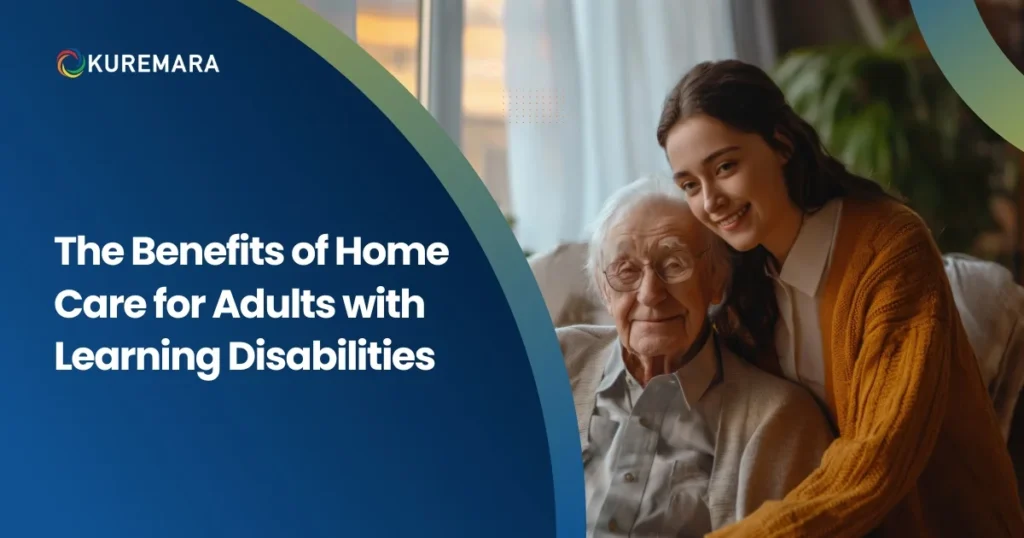
For most of us, home is the one place where we get to be fully ourselves. It is where our routines make sense, where our things are where we left them, and where we feel safe enough to relax. For an adult with a learning disability, that sense of place is not a luxury; it is often the single most important factor in whether they can live a full, dignified, and independent life. Yet for decades, the default response to a learning disability has been to move the person out of their home and into a residential setting, away from their community, their family, and the familiar surroundings that help them thrive.
This blog looks closely at why that approach so often falls short, what actually causes the difficulties adults with learning disabilities face day to day, and how high-quality home care offers a better, more humane, and more effective alternative.
Understanding the Scale of the Problem
Learning disabilities are far more common than many people realise. There are approximately 1.5 million people with a learning disability in the UK, with around 1.3 million of them living in England, representing roughly 2.16% of the adult population. Of the adults known to local authorities, over 127,000 working-age adults and nearly 22,000 older adults received long-term social care support in England in 2023/24. (Source: mencap)
These are not small numbers, and the stakes are high. Adults with a learning disability on average die 19.5 years younger than the general population, and around 39% of those deaths are classed as avoidable, meaning they could have been prevented with good quality, timely healthcare. Beyond health, the picture of daily life is sobering: only about 6% of adults with a learning disability known to their local authority are in paid work, and roughly one in three people with a learning disability spends less than an hour outside their home on a typical Saturday.
What these figures reveal is not a problem with the people themselves, but a problem with the systems and environments built around them. When support is poorly designed, isolation, ill health, and lost independence are the predictable results.
What Actually Causes the Difficulties
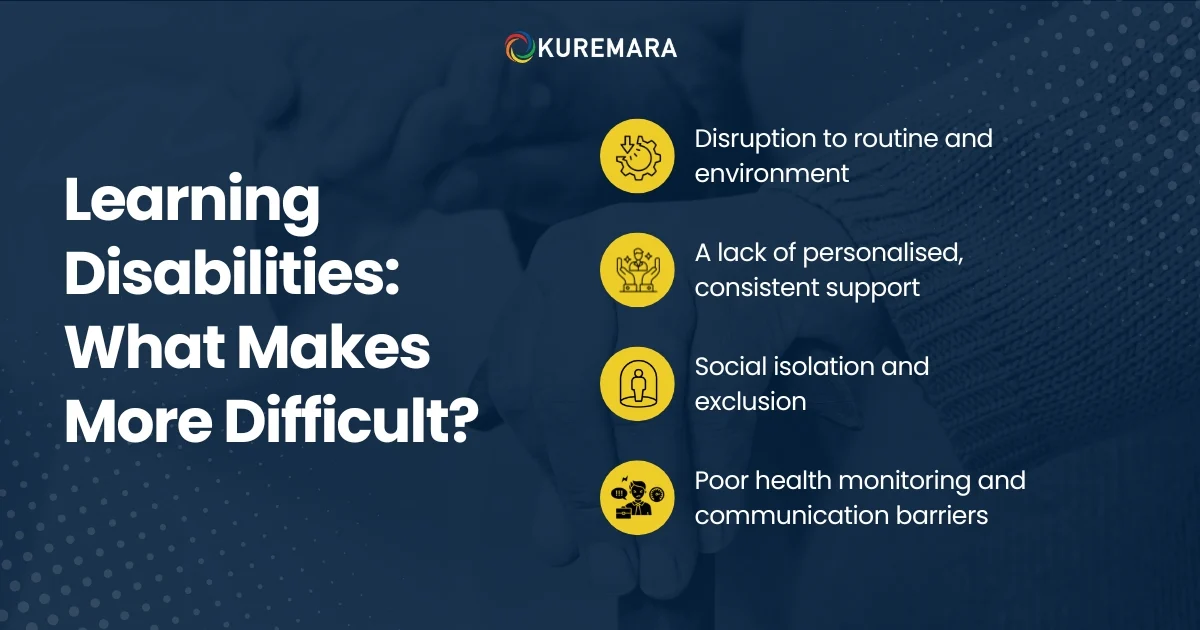
It is tempting to assume that the challenges faced by adults with a learning disability are simply a direct consequence of the disability. In reality, most of the hardship comes from how support is structured, and the wrong structure can make everyday life much harder than it needs to be.
The first major cause is disruption to routine and environment. Many adults with a learning disability rely heavily on predictability. A familiar home, a known sequence to the morning, the same trusted faces, these are the scaffolding that allows a person to feel calm and capable. When someone is moved into an unfamiliar residential or institutional setting, that scaffolding is pulled away all at once. Confusion, anxiety, and behaviour that is labelled “challenging” frequently follow, when in truth the person is responding rationally to a frightening loss of stability.
The second cause is a lack of personalised, consistent support. In group settings, staff often rotate, ratios are stretched, and care is delivered to a schedule that suits the institution rather than the individual. A person who needs longer to communicate, or who has a very specific way of managing their day, gets squeezed into a one-size-fits-all routine. Over time, skills that the person once had can quietly erode because there is no one with the time to encourage them to keep doing things for themselves.
The third, and perhaps most damaging, cause is social isolation and exclusion. When someone is removed from their neighbourhood, their family becomes visitors rather than a daily presence, and their existing friendships and community connections fade. The statistic that many people with a learning disability spend almost no time outside their home is not an accident; it reflects support models that do not prioritise community life. Isolation, in turn, worsens mental and physical health, creating a vicious cycle.
Finally, there is the issue of poor health monitoring and communication barriers. Health professionals have a legal duty to make reasonable adjustments, such as longer appointments or easy-read information, yet these are too often missing. When the people supporting an individual do not know them well, early warning signs of illness are missed, appointments are not properly prepared for, and treatable conditions become serious ones.
The Solution: Why Home Care Works
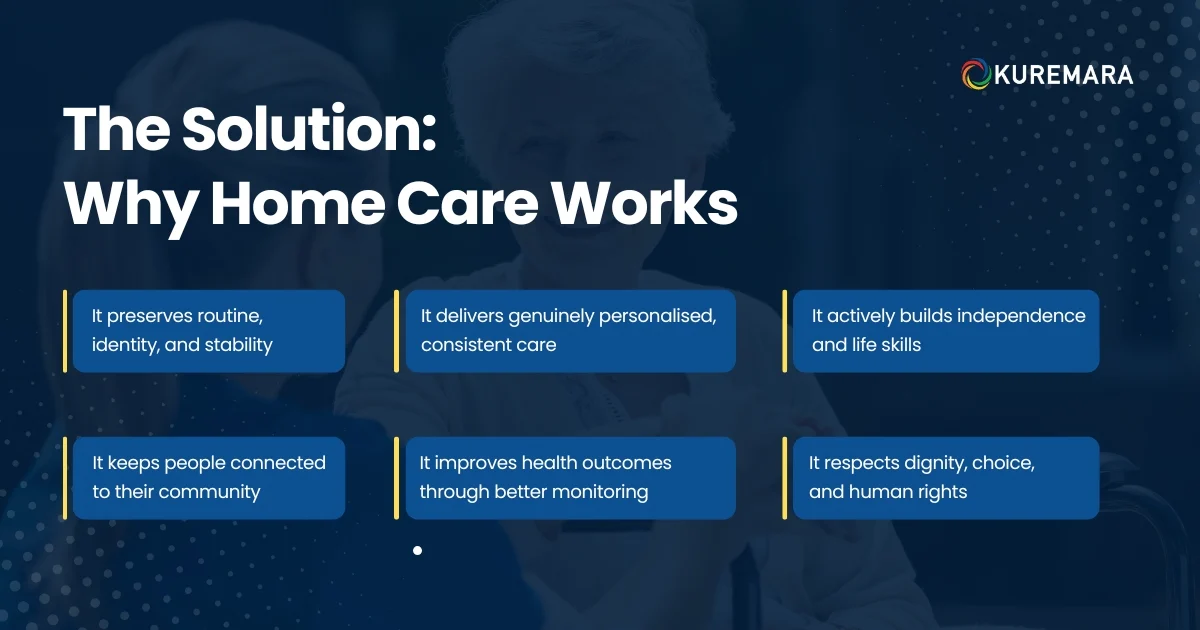
Home care directly addresses each of these causes by keeping the person at the centre and the home as the foundation. Rather than asking the individual to adapt to an institution, home care brings personalised support to the place where the person already feels secure. The benefits are practical and significant.
It preserves routine, identity, and stability. Staying at home means the familiar environment, the personal possessions, the trusted routines, and the established sense of self all remain intact. This stability alone reduces anxiety and so-called challenging behaviour, because the person is not constantly trying to make sense of an alien setting. For many adults with a learning disability, this is the difference between coping and flourishing.
It delivers genuinely personalised, consistent care. Good home care is built around the individual rather than the rota. Support can be tailored precisely, a few hours a week for some, around-the-clock support for others, and crucially, it can flex as needs change. A consistent, well-matched support worker comes to understand the person’s communication style, preferences, triggers, and goals. That continuity is where real progress happens.
It actively builds independence and life skills. Counterintuitively to some, the right home support makes people more independent, not less. Instead of having tasks done for them, individuals are supported and encouraged to cook, manage money, travel, and look after their home with the level of assistance they actually need. The aim is always to do with, not for. Over time, this expands what a person can do on their own and grows their confidence.
It keeps people connected to their community. Because the person stays in their own neighbourhood, existing relationships with family, friends, and local life are maintained rather than severed. Support workers can help the individual access clubs, volunteering, employment, education, and social groups, directly tackling the isolation that harms so many. Living at home is not living in seclusion; with the right support, it is a gateway to a richer community life.
It improves health outcomes through better monitoring. A support worker who knows someone well notices when something is wrong far sooner than a stranger ever could. They can prepare for medical appointments, advocate for reasonable adjustments, ensure medication is managed correctly, and flag concerns early. Given that avoidable deaths remain a serious problem for this group, this consistent, informed oversight can quite literally be life-saving.
It respects dignity, choice, and human rights. Adults with a learning disability have the same right to choose how and where they live as anyone else. Home care honours that right. The person decides what their day looks like, who supports them, and what goals they want to work towards, restoring a sense of control that institutional models so often strip away.
Prevention: Getting Support Right Before Crisis Hits
The most effective home care is not reactive but preventive. Many of the crises that lead to hospital admissions or emergency residential placements can be avoided entirely with the right support in place early.
Prevention starts with a thorough, person-centred assessment that understands not just what someone cannot do, but what they can do, what they want, and what matters to them. From there, a good provider builds a support plan that is reviewed regularly and adjusted as life changes. Proactive health management, regular GP reviews, annual health checks, and close attention to early symptoms head off the avoidable illnesses that disproportionately affect this group. Building life skills steadily, rather than waiting for a crisis, means the person becomes more resilient over time. And keeping families involved as partners in care ensures that support is consistent and that no one is left isolated.
The principle running through all of this is simple: invest in the right support early, in the right place, and you prevent the spiral of isolation, ill health, and lost independence before it begins.
How Kuremara Approaches Home Care
At Kuremara, we believe that an adult with a learning disability should never have to choose between getting the support they need and keeping the home and community they love. Our approach is built entirely around the individual. We take the time to understand each person’s routines, their communication, their hopes, and their goals and we match them with consistent, carefully chosen support workers who can build a genuine, trusting relationship.
Whether someone needs a few hours of support each week or more intensive, around-the-clock care, our plans are personalised and flexible, designed to grow independence rather than create dependence. We focus on community connection, proactive health and wellbeing, and above all on dignity and choice. Across the UK, we work in partnership with the people we support and their families to make independent living at home not just possible, but genuinely fulfilling.
Conclusion
The evidence is clear: the difficulties faced by adults with learning disabilities are driven far more by how and where support is delivered than by the disability itself. Disrupted routines, impersonal care, social isolation, and missed health needs are not inevitable; they are the result of outdated models that move people away from the lives they know. Home care turns that approach on its head. By keeping the person at the centre and the home as the foundation, it preserves stability, builds independence, sustains community ties, protects health, and upholds the fundamental right to choose how to live.
For the 1.5 million people in the UK with a learning disability and the families who love them, that is not a small thing. It is the difference between merely being cared for and being able to live a full, connected, and self-directed life. If you would like to learn more about how Kuremara can support an adult with a learning disability to live well at home, we would be glad to talk with you.