There’s a quiet workforce holding up much of British life, and most of the people in it would never describe themselves that way. They’re daughters and sons, husbands and wives, neighbours and friends. They cook the meals, manage the medication, sit through the hospital appointments, and lie awake listening for movement in the next room. They are the UK’s family carers, and there are millions of them.
According to Carers UK’s 2025 State of Caring survey, around 5.8 million people across the UK are now providing unpaid care for a relative or friend who is older, disabled, or living with a long-term condition. Take the broadest national estimates and the figure climbs higher still, with Carers Week research suggesting close to 12 million people are caring in some capacity. Whatever number you settle on, the message is the same: caring is not a niche experience. It’s one of the most common and most demanding roles a person will ever take on.
And here’s the part that’s so easily overlooked. While everyone’s attention, quite rightly, goes to the person receiving care, the person giving it is frequently running on empty. This article is about them. Specifically, it’s about how a good home care agency doesn’t just support the person being cared for, but it supports the whole family around them.
The person behind the “primary carer.”
Most family carers don’t wake up one morning and decide to take on the role. It arrives gradually. A parent has a fall. A partner receives a diagnosis. What begins as “just helping out a bit” quietly becomes a daily, then hourly, responsibility. Carers UK estimates that roughly 12,000 people take on an unpaid caring role every single day in the UK.
Because the shift is so gradual, many carers never pause to recognise what they’ve become. They don’t claim the support they’re entitled to, they rarely ask for help, and they almost never put their own needs anywhere near the top of the list. In our experience supporting families, this is one of the most consistent patterns we see: the carer who insists they’re “managing fine” right up until the moment it’s obvious they aren’t.
The hidden cost of caring
Caring for someone you love can be profoundly meaningful. It can also be relentless, and the toll it takes is well documented.
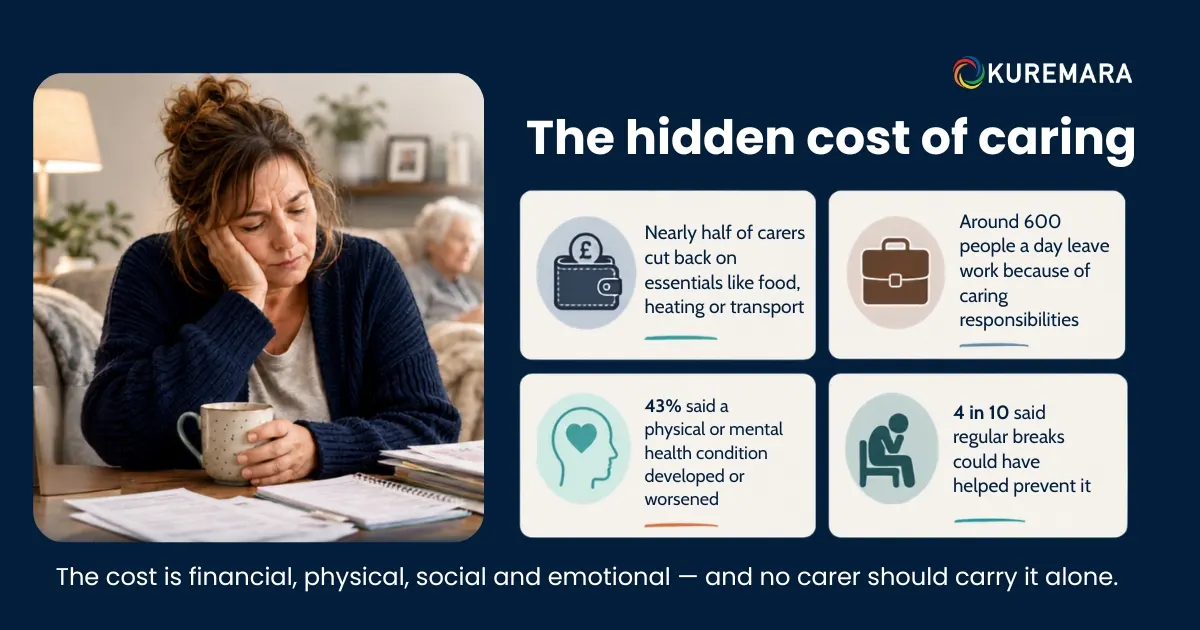
The financial strain alone is considerable. The Carers UK 2025 survey found that nearly half of carers had cut back on essentials such as food, heating, or transport, and a significant proportion had taken on debt simply to cope. Many step away from paid work altogether; Carers UK research points to around 600 people a day leaving employment because of their caring responsibilities.
Then there’s health. A Carers Week 2025 report found that 43% of current or former carers said a physical or mental health condition had developed or worsened since they took on caring. Most strikingly, of those affected, around four in ten believed that simply being able to take regular breaks would have helped prevent it. That single statistic tells you almost everything about why supporting carers matters.
The cost isn’t only physical or financial, it’s social and emotional too. The friendships that quietly fade. The hobbies set aside. The creeping isolation. And the particular guilt that so many carers carry: guilt for feeling exhausted, guilt for wanting time off, guilt for occasionally resenting a situation nobody chose. None of these feelings makes someone a bad carer. They make them human.
Recognising when a carer is running low
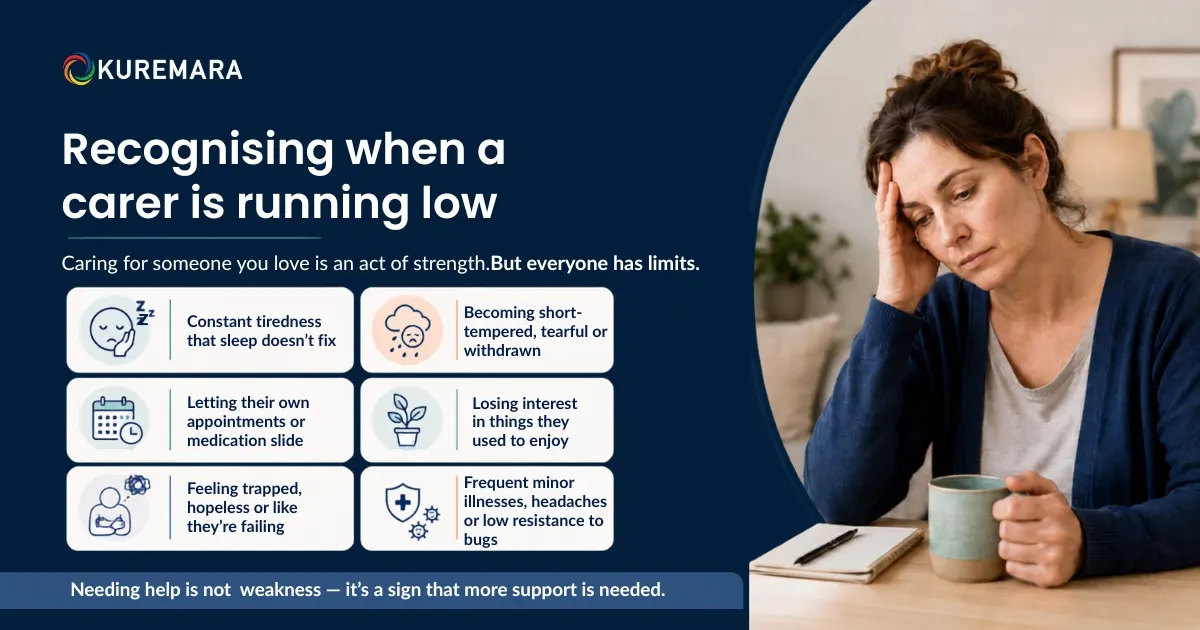
Part of caring well for a carer is knowing what strain looks like before it tips into crisis. The signs are easy to dismiss one at a time, but together they paint a picture worth paying attention to:
- Constant tiredness that sleep doesn’t seem to fix
- Becoming short-tempered, tearful, or withdrawn
- Letting their own health appointments and medication slide
- Losing interest in things they used to enjoy
- Feeling trapped, hopeless, or as though they’re “failing.”
- Frequent minor illnesses, headaches, or a lowered resistance to bugs
If you recognise several of these in yourself or in someone you know who is caring, it isn’t a sign of weakness. It’s a sign that the arrangement needs more hands. And that’s precisely where professional home care earns its place.
What “supporting the carer” actually looks like
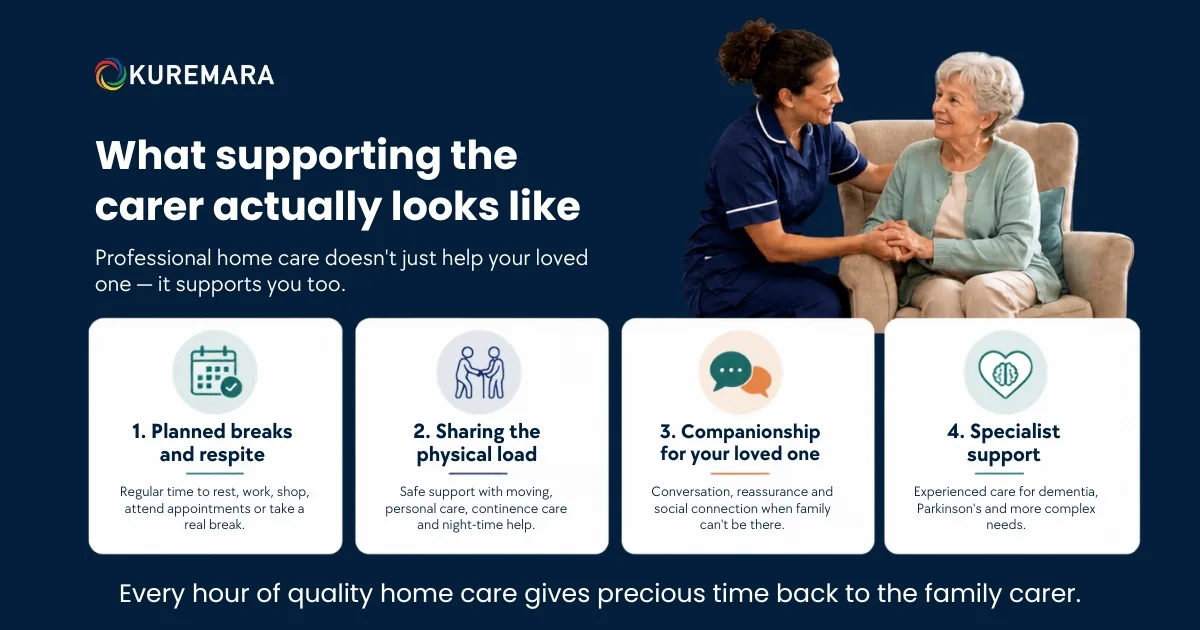
When people picture domiciliary care, they tend to think only of the person receiving it: help with washing and dressing, support with medication, a steady hand with mobility. All of that is true. But every hour a trained carer spends in the home is also an hour handed back to the family carer, and that changes everything.
1. Planned breaks and respite. Perhaps the single most valuable thing a home care agency offers a family carer is permission to step away. Respite comes in many forms: a regular few hours each week so a carer can work, rest, or do the food shop in peace; a sitting service while they attend their own appointments; overnight support so they can finally sleep through the night; or longer planned cover so they can take a genuine holiday. The principle running through all of it is simple: sustainable caring depends on rest, not heroics.
2. Sharing the physical load. Some caring tasks are exhausting, and a few are genuinely unsafe to attempt alone. Moving and handling someone with reduced mobility, managing continence care, or supporting a person repeatedly through the night can take a real physical toll on a family member who has never been trained for it. Professional carers take these tasks on safely, protecting both the person being cared for and the carer’s own back, joints, and wellbeing.
3. Companionship for the person you love. Care isn’t only practical. A reliable carer who shares a cup of tea, a conversation, or a short walk gives the cared-for person a genuine social connection and quietly reassures the family carer that their relative isn’t sitting alone during the hours they can’t be there.
4. Specialist support where it’s needed. Conditions such as dementia, Parkinson’s, or the complex needs that arise towards the end of life call for knowledge and techniques most families have simply never been taught. Bringing in carers with specialist training doesn’t push the family aside; it lifts the weight of tasks they were never equipped to carry, and it usually teaches them a great deal along the way.
More than a rota: the reassurance carers gain
The benefits of good home care reach well beyond the hours actually worked.
For a start, experienced carers act as a second, trained pair of eyes. They often notice the subtle changes a family member seeing their relative every single day might miss: a new unsteadiness, a dip in appetite, the early signs of an infection, a shift in mood. Spotting these early and knowing when and how to escalate to a GP or district nurse can stop a small problem from becoming a hospital admission.
There’s also a quiet transfer of skill that happens naturally. A good carer will gladly show a family member safer ways to assist with moving, practical tips for mealtimes, or simple changes that make a room safer knowledge that builds real confidence for the hours the carer is on their own.
Just as importantly, a reputable agency helps families navigate a system that can feel impenetrable. Knowing which benefits exist, who carries out which assessment, and where to turn next is half the battle, and it’s not a battle any carer should have to fight uninformed.
Know what you’re entitled to
This is where a little expertise goes a long way, because a surprising amount of available support simply goes unclaimed.
1. A carer’s assessment. Under the Care Act 2014, any adult in England who provides regular care has the right to a carer’s assessment from their local authority and, crucially, this right applies regardless of the income or savings of either the carer or the person they look after. The assessment looks at how caring is affecting your health, work, and day-to-day life, and what support might help. Yet Carers UK’s 2025 figures suggest only around a quarter of carers had completed one in the previous year. If you’ve never had a carer’s assessment, it’s one of the most worthwhile phone calls you can make to your council.
2. Carer’s Allowance and related support. For the 2026/27 financial year, Carer’s Allowance is £86.45 per week for those who care for at least 35 hours a week and earn no more than £204 a week after allowable deductions. It isn’t generous, and it comes with a strict earnings “cliff edge,” but for many households it’s a meaningful contribution and it can unlock further help, such as the Carer Element within Universal Credit. The rules are detailed and change each April, so it’s always worth checking your own circumstances on GOV.UK or with a benefits adviser.
3. A voice in hospital discharge. If the person you care for is being discharged from hospital, you have a right under the Health and Care Act 2022 to be involved in the planning, including being asked whether you’re willing and able to provide care once they’re home. You’re allowed to say you need support. You’re allowed to say no.
Care that works with the family, not instead of it
It’s worth dispelling a fear that stops many families from reaching out at all: the worry that accepting help means being pushed aside, or that a relative will feel “handed over to strangers.” Good home care is the very opposite of that.
The best domiciliary care is person-centred and family-inclusive by design. The family carer usually knows the person better than anyone, their history, their preferences, the small routines that make a day run smoothly, and that knowledge is genuinely invaluable. A quality care team treats the family as partners: they listen, they communicate, they adapt the care plan as needs change, and they keep relatives properly informed. The aim was never to replace the love and familiarity a family provides. It’s to surround that care with enough practical support to sustain it for the long haul.
Consider a fairly typical situation: an adult daughter caring for her father, who has early-stage dementia, while holding down a full-time job and raising her own children. Without support, that arrangement tends to end in burnout, a stalled career, and often a premature move into residential care. With a few well-planned hours of home care each week, help with personal care in the mornings, companionship in the afternoons, and a clear point of contact whenever something changes, the same daughter can keep working, stay well, and remain her father’s daughter rather than becoming his round-the-clock nurse. That’s the difference good support makes, and it’s the kind of outcome experienced care teams work towards every day.
Where the right provider makes the difference
This philosophy, caring for two people at once sits at the heart of how Kuremara approaches home care. As a regulated domiciliary care provider in the UK, it builds support around both the person receiving care and the family around them: personalised care plans, trained and compassionate carers, flexible respite, and the kind of steady, honest communication that lets relatives breathe a little easier. The guiding question is always the same: what would genuinely make daily life more manageable for this household, the carer very much included?
A final thought
Caring for someone is one of the most generous things a person can do. But generosity has limits, and a carer who burns out can’t look after anyone, least of all themselves. Supporting the caregiver isn’t a luxury or an afterthought; it’s what makes good care sustainable over months and years rather than weeks.
So if you’re the one quietly holding everything together, take this as your permission slip: asking for help is not a failure of love. It’s how love lasts. The strongest care plans look after two people at once: the person being cared for, and the person doing the caring. You deserve to be one of them.