
Finding home care is emotional enough. Then the quotes arrive… and they’re all different.
One provider may quote a lower hourly rate but include minimum visit lengths and weekend uplifts. Another may look more expensive upfront but include care planning, consistent carers, and stronger oversight. The truth is: home care isn’t a one-size-fits-all service, so pricing can change significantly depending on what support is needed and how it’s delivered.
This guide breaks down the 12 biggest cost drivers that influence home care pricing, so you can compare quotes fairly and choose care that’s right for your family.
Need a clear, transparent quote? Kuremara provides personalised home care with honest pricing and a care plan built around your needs. Reach out to request an assessment and a detailed quote.
Why two home care quotes can be so different
Home care is priced based on real-world delivery: staffing, risk, travel, scheduling, supervision, and the level of support required. Even if two quotes include “10 hours per week,” the cost can change depending on:
- whether those hours are spread across short visits or longer blocks
- whether care is needed evenings, weekends, or bank holidays
- whether a single carer can safely support needs, or if two carers are required
- whether the provider includes care management, reviews, and out-of-hours support
It’s not just about the hourly rate. It’s about what that rate covers and how consistently care can be delivered.
What a home care quote usually includes
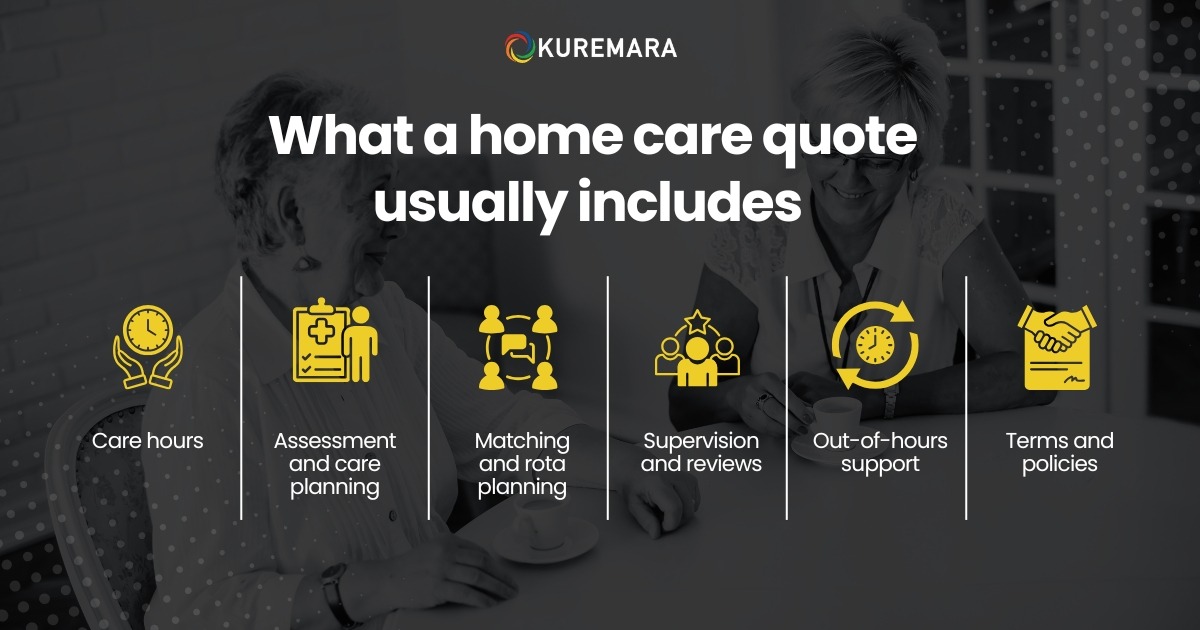
Before we get into the 12 cost drivers, here’s what a professional home care quote typically reflects:
- Care hours: personal care, daily living support, companionship, domestic help (depending on needs)
- Assessment and care planning: understanding medical history, routines, risks, preferences
- Matching and rota planning: staffing, scheduling, continuity planning
- Supervision and reviews: care checks, plan updates, quality monitoring
- Out-of-hours support: escalation pathways for urgent issues
- Terms and policies: minimum visit lengths, cancellations, weekend/bank holiday rates
A simple “compare quotes” checklist
When you receive a quote, ask every provider to confirm:
- What exactly is included in the hourly rate?
- Is there a minimum visit length?
- Are evenings/weekends/bank holidays charged at a higher rate?
- Is travel time included or charged separately?
- Who supervises care, and how often do reviews happen?
- What happens if needs increase?
Now, let’s break down what causes pricing to change.
The 12 cost drivers that change the price of home care
1. Type of Care: Visiting vs. Live-In
The fundamental structure of the care determines the base price.
- Visiting Care: Charged by the hour (typically £25–£35). Ideal for help with mornings, meals, or medication.
- Live-In Care: A carer resides in the home, providing 24/7 peace of mind. While the weekly cost is higher (starting around £1,200–£1,500), it is often more cost-effective than intensive hourly care or a residential nursing home.
2. Clinical Complexity & Specialist Needs
Standard companionship or light housekeeping carries a different rate than clinical support. If a loved one has advanced Dementia, Parkinson’s, or requires catheter care, the carer needs specialist training and higher levels of clinical oversight from a registered manager.
3. Geographical Location
Like most services, geography plays a role. Due to the higher cost of living and staff wages, care in London and the South East generally commands a higher premium than in the North of England. At Kuremara, we ensure our rates are competitive within our local service areas while reflecting the true cost of high-quality staffing.
4. Frequency and Duration of Visits
Shorter visits (e.g., 30 or 45 minutes) often have a higher “per-minute” cost to cover the carer’s travel time and logistics. Conversely, booking longer “blocks” of time or multiple visits per day can sometimes offer better cumulative value.
5. Night-Time Support Requirements
Do you need someone awake and alert all night, or just nearby?
- Sleeping Night: The carer sleeps in a guest room but is available if an emergency arises.
- Waking Night: The carer stays awake the entire shift to provide active support (toileting, repositioning, or monitoring). Waking nights are priced higher due to the intensity of the role.
6. Staff Training and Fair Wages
In 2026, the National Living Wage stands at £12.71. To attract the most compassionate and skilled carers, providers must pay competitive wages that go beyond the legal minimum. A higher quote often indicates that the provider invests in staff retention and ongoing professional development, which leads to better continuity of care for you.
7. Regulatory Compliance (The CQC Factor)
Kuremara is a regulated provider. This means we are inspected by the Care Quality Commission (CQC). Unregulated “introductory agencies” may be cheaper because they don’t provide management, insurance, or rigorous safeguarding oversight. With a regulated provider, you are paying for a managed service that takes full legal responsibility for your loved one’s safety.
8. Weekend and Bank Holiday Premiums
Care is a 365-day-a-year commitment. To ensure we have the best staff available on Christmas Day or a Sunday afternoon, premium rates are applied. These ensure that our dedicated carers are fairly compensated for working during “unsociable” hours.
9. Care for Couples
One of the biggest financial “hacks” in home care is for couples. While a care home would charge for two separate rooms, live-in care for a couple usually only incurs a small “second person” supplement. This can save families thousands of pounds per month compared to residential care.
10. Technology and Care Planning
Modern care isn’t just a paper logbook. We use digital care planning software that allows family members to see real-time updates on their phones. The infrastructure required to maintain this level of communication and data security is factored into the service fee.
11. Travel and Mileage
In more rural UK postcodes, or if a carer is required to take a client to medical appointments or social outings, mileage charges may be added. We always disclose these upfront so there are no “hidden” invoices.
12. Level ofPersonalisation
Bespoke care is exactly that, tailored. A plan that includes complex meal preparation, physical therapy assistance, and social integration requires more coordination than a basic check-in. The more “wraparound” the service, the more time is invested by the management team to ensure it runs perfectly.
How to compare home care quotes fairly

To compare quotes properly, bring everything back to like-for-like:
Step 1: Match the care schedule
Confirm:
- exact days and times
- visit lengths
- whether weekends or evenings are included
- whether overnights are needed
Step 2: Match the care level
Ask:
- is this 1:1 care or 2:1 care?
- is the provider pricing for higher-risk support needs?
- what training or experience does the carer need?
Step 3: Confirm what’s included
Make sure each provider clarifies:
- assessment and care plan inclusion
- supervision and reviews
- out-of-hours support
- travel time and mileage
- bank holiday rates
- cancellation and change policies
Red flags to watch for
Be cautious if a provider:
- offers a quote without a proper assessment
- won’t clearly explain what’s included
- avoids discussing safeguarding and escalation
- pressures you into a quick decision
- has unclear documentation or inconsistent terms
Real-world examples (why pricing shifts quickly)
Here are simple illustrations of how the same “weekly hours” can price differently:
- Example A: Daytime support + longer visits
Typically more efficient to staff, fewer travel gaps, lower risk.
- Example B: Multiple short visits across mornings/evenings + weekends
More rota complexity and uplifts, often higher overall cost.
- Example C: Two-carer mobility support + waking nights
High staffing intensity, higher oversight, typically the highest cost bracket.
These examples show why comparing “hourly rate” alone rarely tells the full story.
How Kuremara approaches home care quotes
At Kuremara, we believe families deserve clarity, especially when making an important decision under pressure.
Our approach is built around:
- Assessment-led planning: we quote after understanding needs, routines, and risks
- Transparent breakdowns: you can see what’s included and why
- Care built for consistency: we aim for stable routines and reliable coverage
- Ongoing reviews: care can evolve as needs change
- Clear escalation and support: you’re not left guessing what happens after hours.
If you want a quote that reflects real care delivery without vague pricing, we’re here to help.
Conclusion
Home care quotes vary because home care is personal. The right quote should reflect:
- your loved one’s needs and safety
- practical scheduling realities
- reliable staffing and continuity
- proper supervision and support behind the scenes
Instead of chasing the cheapest rate, aim for clear value: transparent terms, safe staffing, consistent carers, and a plan that adapts as life changes.
If you’d like a clear home care quote and a tailored care plan, contact Kuremara today to request an assessment and get started.