Nobody likes to think about emergencies. It feels counterintuitive even a little uncomfortable to sit down and plan for the moments we hope will never happen. But here’s the thing: if you have a loved one receiving home care, a bit of preparation now can make an enormous difference when it matters most.
At Kuremara, we work closely with families across the UK to ensure that care at home is not just compassionate and consistent but also safe and resilient. Part of that commitment means helping families put the right structures in place before an unexpected situation arises.
The good news? You don’t need a whole weekend to do this. With about 20 minutes, a cup of tea, and the checklist below, you can create a robust home emergency plan that your entire family, and our care team can rely on.
Step 1: Build Your Emergency Contact Sheet
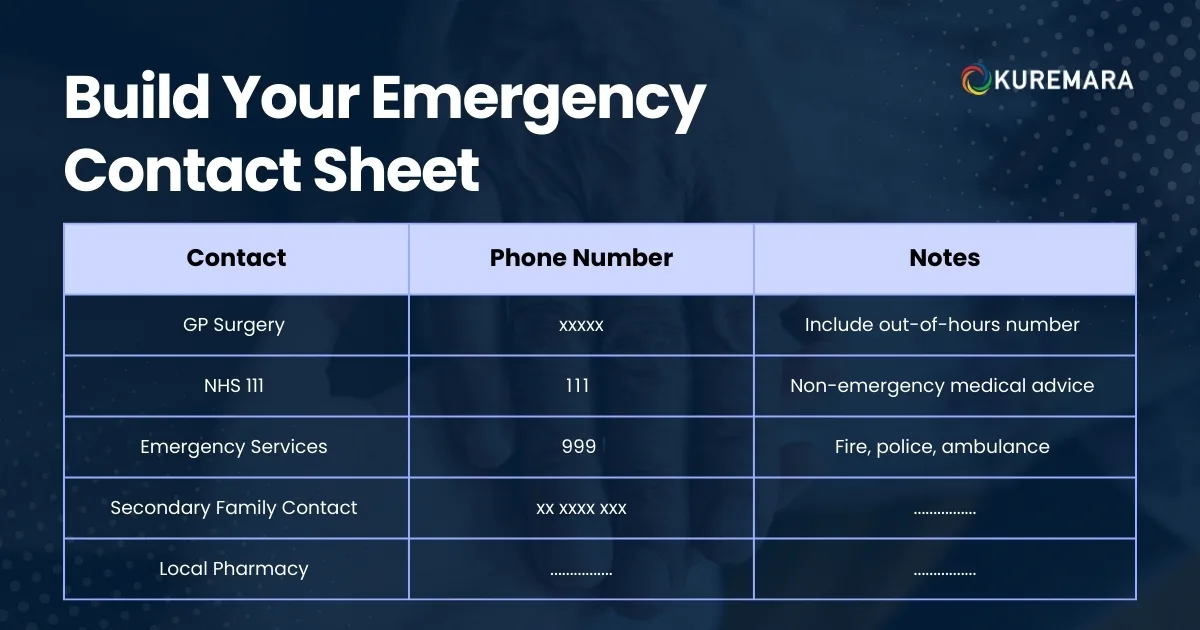
The first and arguably most important thing you need is a single, clearly written contact sheet. Not saved only on someone’s phone. Not buried in an email thread. A physical document (or a pinned digital one that everyone can find) with the following details:
Contact | Phone Number | Notes |
GP Surgery |
| Include out-of-hours number |
NHS 111 | 111 | Non-emergency medical advice |
Emergency Services | 999 | Fire, police, ambulance |
Kuremara Care Team | 0330 111 5400 | Your 24/7 support line |
Primary Family Contact |
| Name + relationship |
Secondary Family Contact |
| Name + relationship |
Trusted Neighbour |
| Key holder if applicable |
Local Pharmacy |
| Name + opening hours |
Hospital A&E (nearest) |
| Address + postcode |
Pro tip: Print this sheet and keep one copy on the fridge door, one in the care folder, and one saved to the shared family group chat. Visibility is everything in an emergency.
Step 2: Set Up a Key Safe
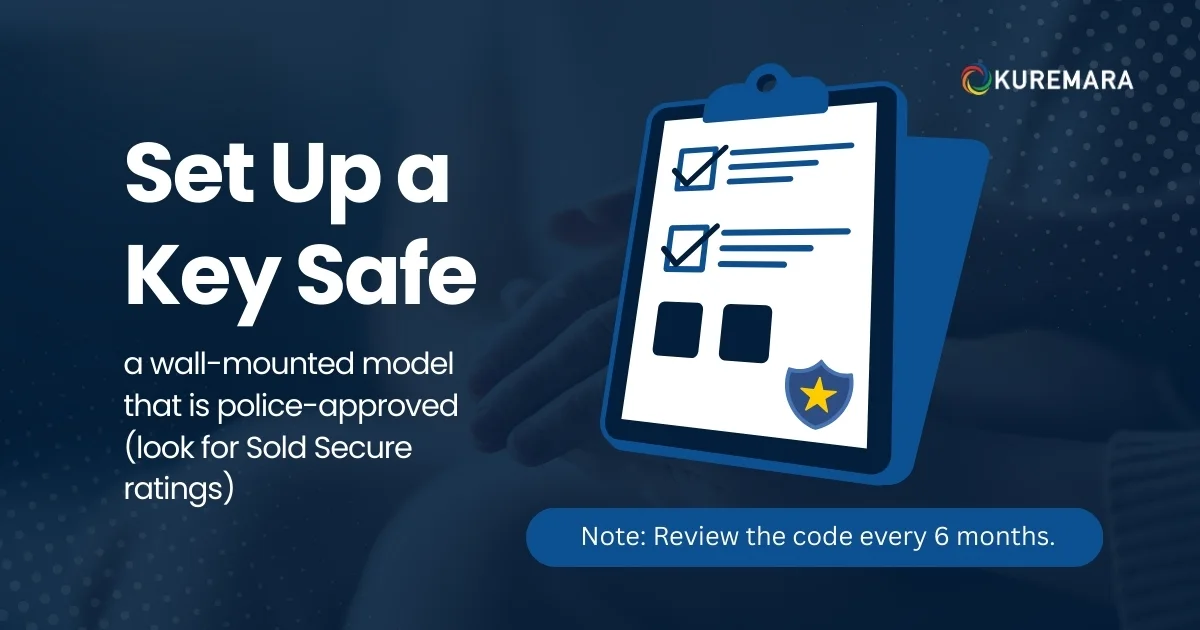
A key safe is one of the simplest and most overlooked safety tools available to home care clients and their families. Fitted externally to the wall near the front door, it stores a key behind a pin-code lock that authorised people can access.
Why it matters:
- If your loved one cannot get to the door in an emergency, carers and paramedics can enter safely without forcing entry.
- It eliminates delays when a regular carer is replaced at short notice.
- Family members who don’t have a spare key can still access the property in a crisis.
- It removes the need to hide keys under mats which is far less secure.
Your checklist for key safe setup: Choose a wall-mounted model that is police-approved (look for Sold Secure ratings), install it at a height that’s practical but not immediately obvious, share the code with your Kuremara care coordinator, and review the code every 6 months.
Step 3: Create a Medication List

This is one of the most critical documents in any home care emergency plan, yet it’s frequently out of date or incomplete. In a medical emergency, paramedics and A&E staff need accurate medication information immediately. Guesswork in those moments can be genuinely dangerous.
Your medication list should include:
a. Full name of each medication
b. Dosage and frequency (e.g. 5mg, twice daily with food)
c. What it is prescribed for
d. Prescribing GP or specialist
e. Any known allergies or adverse reactions
f. Over-the-counter medications and supplements being taken regularly
g. Date last reviewed by a healthcare professional
Keep this list with the medication itself, ideally in a clearly labelled folder or pouch. Our Kuremara carers are trained to assist with medication management and will always cross-reference this document during their visits. Make sure the list is updated whenever a GP makes any prescription changes.
Step 4: Record Your GP Details (And Know the Out-of-Hours Process)
It sounds obvious, but in a moment of panic, even familiar information can slip from memory. Having GP details written down, not just stored in someone’s phone, means that anyone who needs them can act quickly.
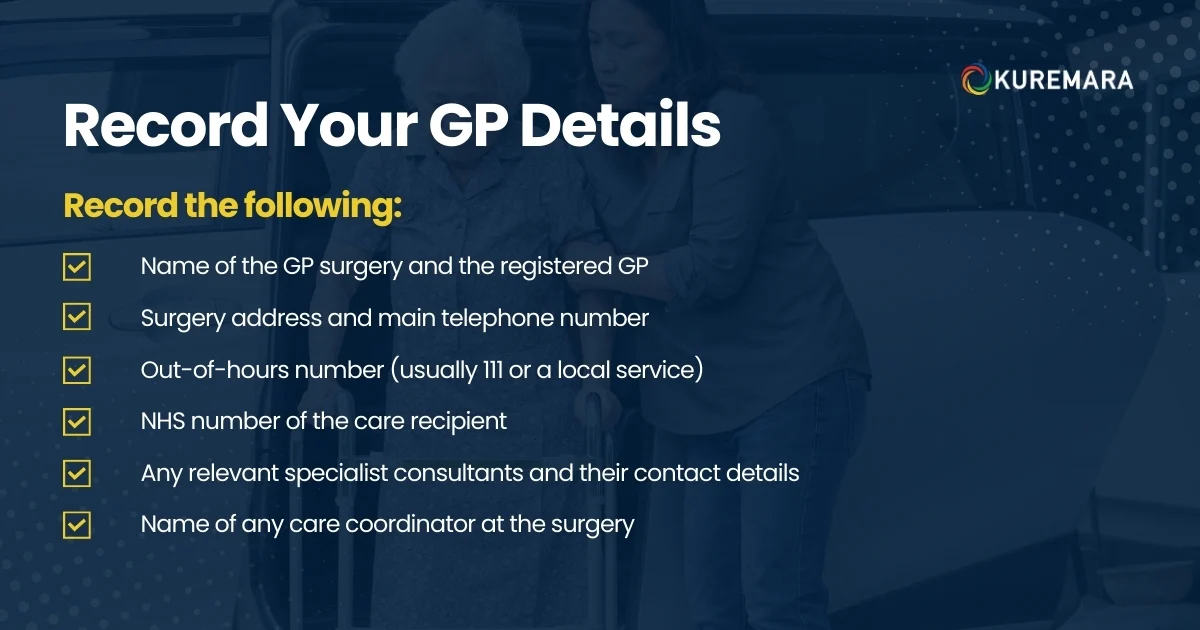
Record the following:
- Name of the GP surgery and the registered GP
- Surgery address and main telephone number
- Out-of-hours number (usually 111 or a local service)
- NHS number of the care recipient
- Any relevant specialist consultants and their contact details
- Name of any care coordinator at the surgery
Remember: If your loved one’s GP is unavailable, NHS 111 should always be your first port of call for non-emergency medical advice. For anything urgent, always call 999 without hesitation.
Step 5: Map Out Your Escalation Steps
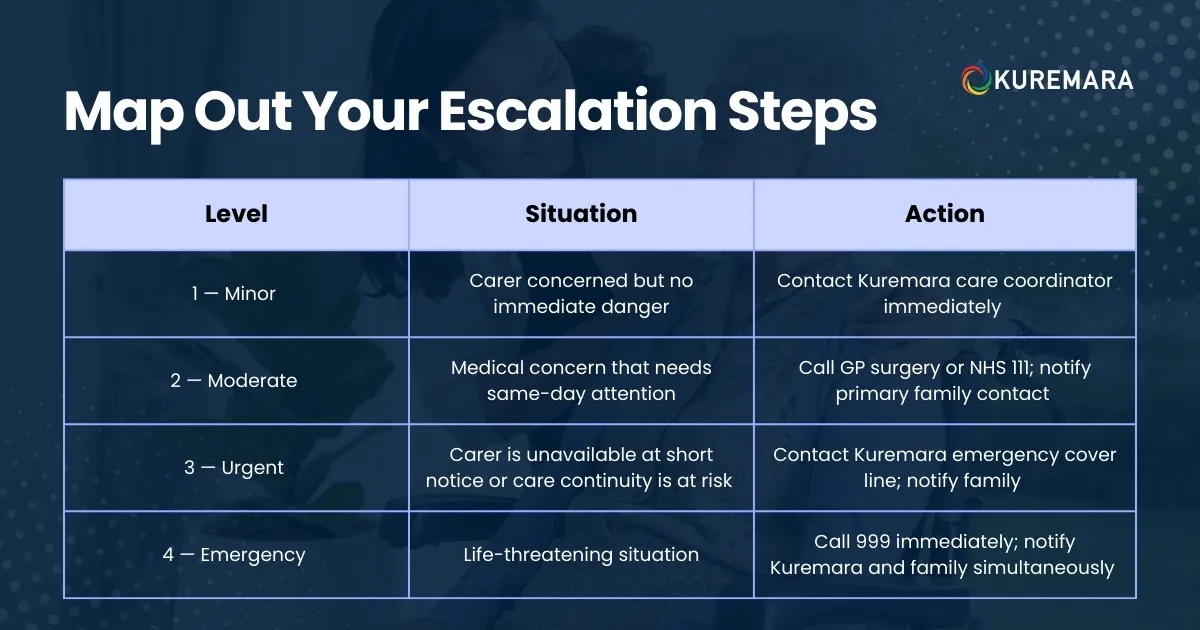
An escalation plan answers one simple question: if something goes wrong, who does what, in what order? Having this written down means that even a family member who doesn’t usually manage care, perhaps a sibling who lives further away, can step in and take the right actions without delay.
Level | Situation | Action |
1 — Minor | Carer concerned but no immediate danger (e.g. mild fall, change in behaviour) | Contact Kuremara care coordinator immediately |
2 — Moderate | Medical concern that needs same-day attention (e.g. infection symptoms, confusion) | Call GP surgery or NHS 111; notify primary family contact |
3 — Urgent | Carer is unavailable at short notice or care continuity is at risk | Contact Kuremara emergency cover line; notify family |
4 — Emergency | Life-threatening situation (e.g. suspected stroke, serious injury, chest pain) | Call 999 immediately; notify Kuremara and family simultaneously |
Write names and phone numbers next to each action, not just job titles. When stress levels are high, people act faster when they know exactly who they’re calling.
Step 6: Understand How Kuremara Coordinates With Your Family
One of the things that sets professional home care apart from informal arrangements is the ability to coordinate. At Kuremara, family communication isn’t an afterthought; it’s built into how we work.
Here’s what that looks like in practice:
a. Your designated family contact is recorded in your loved one’s care plan from day one. Our team knows who to call, when, and why.
b. All carers are trained to escalate concerns through a clear internal process before, during, and after any emergency situation.
c. If a regular carer is unwell or unavailable, we coordinate a cover carer and notify the family, there are no gaps in care.
d. Our care coordinators are reachable outside of standard office hours for urgent matters.
e. If hospital admission occurs, we liaise with the discharge team to ensure a smooth transition back to home care.
We always recommend that families share this emergency plan with our care coordinators so that everyone is working from the same information. The more visibility we have, the more effectively we can support your loved one in any situation.
Your 20-Minute Emergency Plan Checklist
Ready to get started? Work through these in one sitting and you’ll have a complete plan in place before your next cup of tea goes cold.
EMERGENCY PLAN MASTER CHECKLIST
* CONTACTS & ACCESS
☐ Emergency contact sheet created with all numbers
☐ Physical copy stored on fridge / in care folder
☐ Digital copy shared with all family members
☐ Key safe installed and code shared with Kuremara
☐ Key safe code reviewed in the last 6 months
* MEDICAL INFORMATION
☐ Medication list is complete and up to date
☐ NHS number recorded and accessible
☐ GP surgery details noted (including out-of-hours)
☐ All known allergies clearly documented
☐ Relevant specialist contacts included
* PLAN & PROCESS
☐ Escalation plan written and shared with family
☐ Named primary and secondary family contacts agreed
☐ Kuremara care coordinator contact added to all phones
☐ Emergency plan shared with Kuremara team
☐ Date set to review and update the plan (every 6 months)
A Final Thought From the Kuremara Team
Preparing an emergency plan isn’t about expecting the worst. It’s about giving yourself, your family, and your loved one the best possible chance of a calm, coordinated response if things don’t go to plan.
At Kuremara, we believe that great care is always a partnership, between our trained professionals, the families we serve, and the wider healthcare system. An emergency plan is one of the most practical expressions of that partnership. It says: we’ve thought ahead, we’re organised, and we’re ready.
If you’d like help creating or reviewing your loved one’s care plan, or if you have any questions about our emergency cover service, our team is here to help. Reach us on 0330 111 5400 or visit kuremara.co.uk, because being prepared is the most loving thing you can do.