Growing older at home is a wish shared by most people in the UK. Research from Age UK consistently shows that the overwhelming majority of older adults would prefer to remain in familiar surroundings rather than move into residential care. Yet wishing for it and planning for it are two very different things. A home that served a family beautifully for thirty years can quietly become the very thing that puts a loved one at risk a loose stair runner, a high-sided bath, a poorly lit hallway.
Preparing your home for age-friendly living isn’t about turning it into a clinical environment. It’s about making thoughtful, often surprisingly small changes that protect independence, dignity, and confidence for years to come. This guide walks you through how to approach that planning sensibly, room by room, with practical advice tailored to homes across the UK.
Why Age-Friendly Planning Matters Sooner Than You Think
Most families start thinking about home adaptations after something has already gone wrong, a fall, a hospital stay, a worrying near-miss on the stairs. The truth is, the best time to plan is before any of that happens.
A proactive approach gives you three significant advantages:
- Lower costs. Adaptations made gradually, on your own timeline, are far cheaper than emergency modifications made under pressure.
- Better outcomes. Older adults adjust to changes much more easily when they’re introduced calmly, rather than after a hospital discharge.
- Greater independence. A well-prepared home can delay or even prevent the need for residential care, allowing your loved one to stay where they feel most themselves.
Think of age-friendly planning as a long-term investment in wellbeing, one that pays dividends in safety, comfort, and peace of mind for the whole family.
Start With an Honest Home Assessment
Before buying a single grab rail, walk through the home with fresh eyes. The goal is to spot hazards that have become invisible through familiarity.
Ask yourself:
- Are there rugs, cables, or clutter that could cause trips?
- Is lighting bright and even, particularly in hallways and on stairs?
- Are commonly used items – kettle, kitchen utensils, bathroom essentials, within easy reach without bending or stretching?
- Can your loved one move from room to room without needing to grip walls or furniture for support?
- Are doorways wide enough should a walker or wheelchair ever be needed?
If you’d like a more thorough evaluation, you can request a free home assessment from an occupational therapist through your local council in England, Scotland, Wales, or Northern Ireland. They can recommend specific changes and may also help you access funding through a Disabled Facilities Grant for major adaptations.
Room-by-Room: Practical Adaptations That Make a Real Difference
1. The Entrance and Hallway
The journey into the home should be safe and welcoming, not an obstacle course.
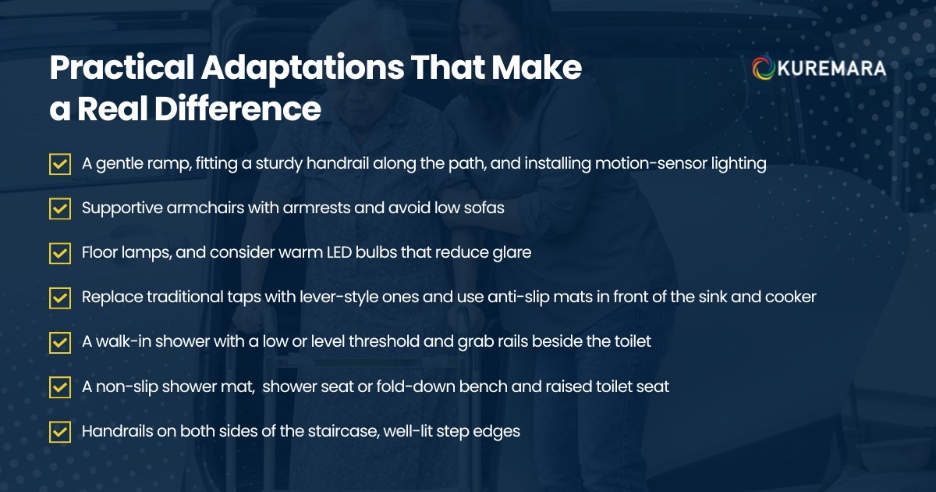
Consider replacing steep front steps with a gentle ramp, fitting a sturdy handrail along the path, and installing motion-sensor lighting, so no one has to fumble for switches in the dark. Inside the hallway, remove loose mats, the leading cause of trips in older adults and ensure there’s a sturdy chair or bench near the door for putting on shoes safely.
A keysafe outside the property is also worth considering. It allows trusted carers, family members, or emergency responders to access the home without your loved one needing to hurry to the door.
2. The Living Room
This is where many older adults spend the bulk of their day, so comfort and safety should work hand in hand.
Choose firm, supportive armchairs with armrests that make standing up easier. Avoid low sofas, which can be genuinely difficult to rise from. Arrange furniture to create clear walking paths; at least 90cm wide if possible, and tuck away electrical cables so they aren’t a tripping hazard.
Good lighting matters enormously. As we age, our eyes need significantly more light to see clearly. Layer your lighting with overhead fixtures, table lamps, and floor lamps, and consider warm LED bulbs that reduce glare while remaining energy-efficient.
3. The Kitchen
The kitchen is one of the most rewarding rooms to adapt to because small changes can restore confidence in a space many older adults gradually start to avoid.
Move frequently used items of tea, biscuits, plates, and mugs to lower shelves between waist and shoulder height. Replace traditional taps with lever-style ones, which are far easier for arthritic hands. Anti-slip mats in front of the sink and cooker reduce fall risk on tiled floors.
If budget allows, induction hobs are a brilliant upgrade. They don’t produce an open flame; the surface stays cooler than gas or traditional electric hobs, and many models switch off automatically if a pan is removed, a genuine safety net for someone who might become forgetful.
4. The Bathroom
This is the single most important room to address. Wet floors, hard surfaces, and the simple act of stepping over a bath rim make bathrooms the most common location for falls in the home.
Priorities here include:
- A walk-in shower with a low or level threshold, replacing the traditional bath where possible
- Grab rails beside the toilet and inside the shower (proper screw-fitted ones, not suction-cup versions)
- A non-slip shower mat or textured shower tray
- A shower seat or fold-down bench for those who tire when standing
- A raised toilet seat if rising from a standard one becomes difficult
- Lever taps and a thermostatic mixer to prevent scalding
Small touches like a heated towel rail at an accessible height and a clearly marked emergency pull cord (especially valuable for those living alone) round out a well-planned bathroom.
5. The Bedroom
A good bedroom setup supports both restful sleep and safe movement during the night.
The bed should be at a height where your loved one can sit on the edge with feet flat on the floor neither too low nor too high. Bedside lamps with easy-touch switches mean no fumbling at 3am. Nightlights along the path to the bathroom prevent disoriented falls during nighttime trips.
Wardrobes and drawers should be reorganised so daily essentials sit at comfortable heights. Consider installing a bedside phone, a personal alarm pendant, or a simple intercom system if other family members live in the same home.
6. Stairs and Upper Floors
Stairs become more challenging with age, but you don’t always have to give up the upstairs.
Start with the basics: handrails on both sides of the staircase, well-lit step edges (contrasting tape on the nosing helps), and a non-slip stair runner secured properly. Remove anything stored on the steps, a remarkably common but dangerous habit.
If stairs become a genuine barrier, a stairlift is often a far more affordable solution than people expect, particularly if bought reconditioned. For some households, reorganising the home so a bedroom and full bathroom exist on the ground floor is a simpler long-term solution.
Bringing Technology Into the Home Thoughtfully
Modern technology has transformed what’s possible for older adults living independently, but only when introduced in a way that suits the person, not the gadget.
Useful options to explore include:
- Personal alarm systems worn as pendants or wristbands that connect to a 24/7 response service
- Smart doorbells that allow your loved one to see who’s at the door without rushing
- Voice assistants for hands-free reminders, calls, and music
- Medication reminder dispensers that lock and unlock at scheduled times
- Movement sensors that quietly alert family members if normal patterns change
The golden rule: pick technology that simplifies daily life and avoid overwhelming someone with too many devices at once. One well-chosen tool used confidently is worth more than five gadgets gathering dust.
Planning the Financial Side
Home adaptations cost money, but many families are unaware of the support available in the UK.
A few starting points:
- Disabled Facilities Grants of up to £30,000 in England (different limits apply in Wales, Scotland, and Northern Ireland) are available through local councils for significant adaptations.
- Attendance Allowance is a non-means-tested benefit for those over State Pension age who need help with personal care.
- VAT relief is available on certain disability-related home modifications.
- Charitable grants from organisations such as Independence at Home or Turn2us can help bridge funding gaps.
It’s also worth speaking to a financial adviser who specialises in later-life planning. They can help you weigh options like equity release, savings, and care funding, ensuring decisions made now don’t create problems later.
Knowing When to Bring in Professional Support
A well-prepared home is a foundation, not a complete answer. There may come a point when a few additional hours of professional care each week make all the difference between struggling and thriving.
Watch for signs such as:
- Increasing forgetfulness around medication
- Reduced personal care or hygiene
- Weight loss or signs of poor nutrition
- Withdrawal from social contact
- Increased anxiety, particularly at night
When that moment arrives, choosing a trusted home care provider matters enormously. A good provider works with families, not around them; listening to your loved one’s preferences, respecting routines built over a lifetime, and adjusting support as needs change.
At Kuremara, we believe home care should feel like an extension of family rather than an intrusion. Whether someone needs companionship a few mornings a week, help with personal care, or more comprehensive support, the right care plan should fit the person never the other way around.
A Final Word: Plan Together, Not For
Perhaps the most important piece of advice in this entire guide is this: involve your loved one in every decision.
Adaptations imposed on an older adult, however well-intentioned, often end up resented or quietly abandoned. Adaptations chosen together, at a pace that feels comfortable, become genuine improvements to daily life. Sit down with a cup of tea. Walk through the home together. Talk openly about what feels safe, what feels frustrating, and what they’d like the next chapter to look like.
Age-friendly living isn’t about preparing for decline. It’s about making sure the home that has held so many memories is ready to hold many more safely, comfortably, and on your loved one’s own terms.
Kuremara provides personalised home care services across the United Kingdom, helping older adults live well in the comfort of their own homes. To discuss how we can support your family, get in touch with our care team for a free, no-obligation consultation.