
Reviewed by the Kuremara Care Team · CQC-registered domiciliary care provider
When a family first arranges support for a loved one with Parkinson’s, almost everyone starts from the same place: good intentions and very little specialist knowledge. That’s completely normal. Parkinson’s is one of the most misunderstood long-term conditions in the UK, and the gap between “helping out” and delivering genuinely effective care is wider than most people realise.
Over years of supporting families across the UK, we’ve noticed the same avoidable mistakes come up again and again. None of them happen through carelessness. They happen because Parkinson’s behaves differently from almost every other condition families have dealt with before. This article walks through what families most often get wrong at home, why it matters, and what good care actually looks like in practice.
If you’re looking for a full overview of our service first, you can read about our specialist Parkinson’s care at home. This piece is about the mistakes that undermine even well-organised care.
Mistake 1: Treating medication timing as “roughly on schedule”
This is the single biggest error we see, and it’s the one with the most immediate consequences.
Parkinson’s medication is not like a blood pressure tablet you can take with breakfast whenever breakfast happens. Many Parkinson’s drugs, particularly levodopa, have a short half-life, meaning the effect wears off within a few hours. When a dose is even 30 minutes late, symptoms can start returning: tremor, stiffness, slowness, and difficulty walking. Clinicians call this “off time,” and for the person experiencing it, an hour of being unable to move or get out of a chair is genuinely distressing.
Parkinson’s UK runs a long-standing campaign called Get It On Time precisely because late doses cause real harm. The Care Quality Commission classes Parkinson’s medicines as “time-sensitive,” meaning the schedule is a clinical requirement, not a suggestion.
a. What families get wrong: administering medication “when we remember,” rounding a 7:00 am dose to whenever the morning routine gets there, or assuming a 20-minute delay makes no difference.
b. What good care looks like: medication given to the minute against the prescribed schedule, doses logged, and any missed or delayed dose flagged. It also means never stopping Parkinson’s medication suddenly, which can cause severe complications and should only ever be changed by a specialist.
A practical tip we give every family: build the whole day around medication times, not the other way around. Meals, exercise, and appointments should flex to fit the drug schedule.
Mistake 2: Planning the day without accounting for “on” and “off” periods
Parkinson’s symptoms fluctuate through the day. There are “on” periods when medication is working well, and movement is easier, and “off” periods when it isn’t. Families often plan a shower, a walk, or a hospital appointment for a fixed time, then feel frustrated when their loved one “won’t cooperate.”
The person isn’t being difficult. Their body simply cannot do the task in that window.
What good care looks like: scheduling the most demanding activities, personal care, exercise, going out, during the person’s reliable “on” periods, and building in calmer, low-demand tasks for when symptoms peak. Observing and recording these patterns over a week or two makes the whole day smoother for everyone.
Mistake 3: Rushing and doing too much for the person
Instinct tells families to help by taking over. With Parkinson’s, that instinct often backfires.
Movement in Parkinson’s is slower, and initiating movement- that first step, standing from a chair- can be the hardest part. When a family member hurries the process or does everything themselves, two things happen: the person loses confidence and independence faster, and rushed transfers actually increase the risk of falls.
What good care looks like: patience and cueing rather than taking over. Trained carers use verbal and visual cues (“big step,” counting, a target on the floor) to help someone initiate movement, and allow the extra time a task genuinely needs. The goal is to support independence, not replace it.
Mistake 4: Underestimating falls and freezing
“Freezing of gait”, the sudden sensation that the feet are glued to the floor, is one of the most dangerous features of Parkinson’s, and it’s frequently the moment a fall happens. Families often don’t recognise freezing for what it is, or try to physically pull the person forward, which makes it worse.
What good care looks like: carers trained in specific techniques for freezing episodes, safe transfer methods, and home environments set up to reduce risk, clear walking routes, removed trip hazards, and good lighting. Our approach to safe movement and fall prevention is built into every Parkinson’s care plan.
Mistake 5: Ignoring swallowing, speech, and nutrition changes
Parkinson’s doesn’t only affect the arms and legs. It can quietly affect swallowing (dysphagia), the volume and clarity of speech, and appetite. Families sometimes miss the early signs- a bit of coughing at meals, a quieter voice, unintended weight loss- until they become serious.
Swallowing difficulties in particular carry a real risk of choking and chest infections, and need proper attention.
What good care looks like: watching for these changes, adapting meal textures and mealtime pacing where needed, working alongside speech and language therapists and dietitians, and raising concerns early rather than waiting.
Mistake 6: Constantly changing who provides the care
Parkinson’s care depends on knowing the person: their routine, their “on” and “off” pattern, the exact cues that help them move, how they like things done. A rotating cast of unfamiliar carers has to relearn all of this every visit, and consistency collapses.
What good care looks like: a small, familiar care team who use the same techniques and know the person’s routine intimately. Continuity isn’t a nice-to-have in Parkinson’s; it’s what makes the difference between care that works and care that constantly resets.
Mistake 7: Forgetting the non-motor and emotional side
Parkinson’s is often thought of as a movement disorder, but its non-motor symptoms- sleep disruption, constipation, low mood, anxiety, and fatigue- can affect quality of life just as much. Families focused on mobility can overlook these, and the person can feel isolated or misunderstood.
What good care looks like: care that treats the whole person. Companionship, conversation, mental stimulation, and emotional reassurance are part of good Parkinson’s support, not extras. Staying socially and mentally engaged genuinely helps people live well with the condition.
Mistake 8: Waiting too long to bring in specialist support
Perhaps the most common regret we hear is: “We wish we’d asked for help sooner.” Families often push on alone until a crisis, a fall, a hospital admission, or exhaustion forces a change. By then, options are narrower, and stress is higher.
Bringing in trained support earlier, even a few hours a week, protects the person’s independence, gives family carers a sustainable role, and puts the right routines in place before a crisis, not after one.
A quick self-check for families
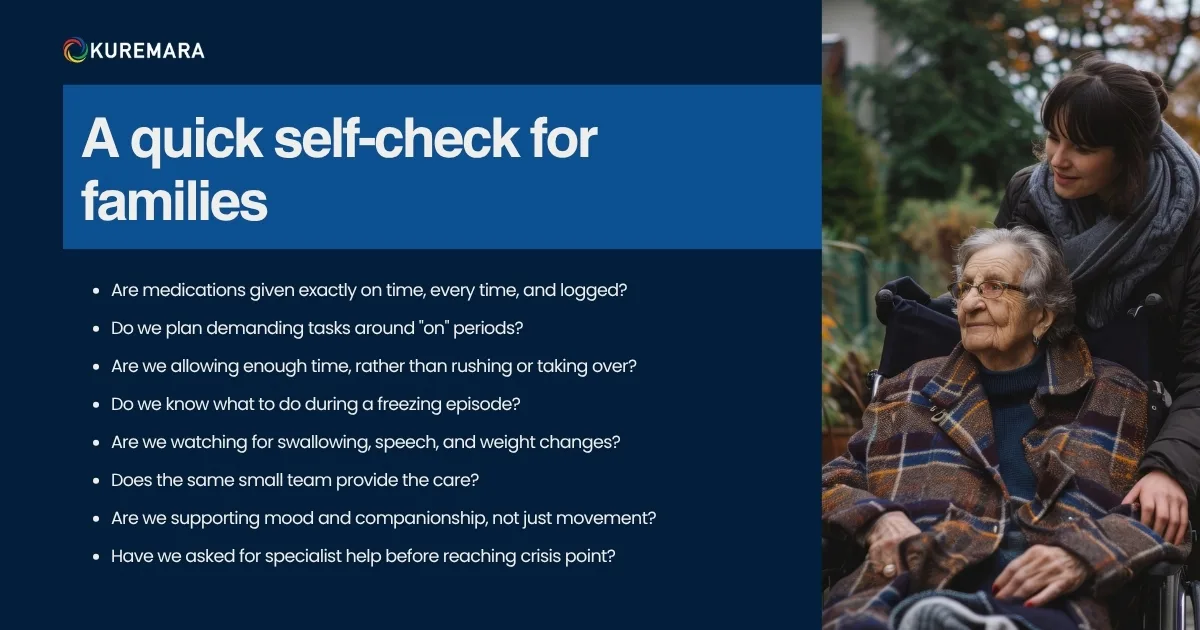
If you’re caring for someone with Parkinson’s at home, ask yourself:
- Are medications given exactly on time, every time, and logged?
- Do we plan demanding tasks around “on” periods?
- Are we allowing enough time, rather than rushing or taking over?
- Do we know what to do during a freezing episode?
- Are we watching for swallowing, speech, and weight changes?
- Does the same small team provide the care?
- Are we supporting mood and companionship, not just movement?
- Have we asked for specialist help before reaching crisis point?
A “no” to any of these is worth a conversation, not a cause for guilt. Parkinson’s is complex, and getting this right takes specialist knowledge that no family is expected to have on day one.
How Kuremara supports families
At Kuremara, our carers are trained specifically in the realities of Parkinson’s, medication timing, safe movement, symptom fluctuation, and holistic support. As a CQC-registered domiciliary care provider, we build individually tailored plans around each person’s routine and changing needs, whether that’s a few visiting hours a week or full live-in support.
If any of the mistakes above feel familiar, that’s a sign it may be time for a conversation, not a sign that anyone has failed. To explore what specialist support could look like for your family, learn more about our Parkinson’s care at home or contact our team for a free, no-obligation home assessment.
Frequently asked questions
1. Why is medication timing so important in Parkinson’s?
Many Parkinson’s medicines wear off within a few hours, so even a short delay can bring back symptoms such as tremor, stiffness, and difficulty moving. The CQC treats these as time-sensitive medicines, and doses should be given exactly on schedule.
2. What is an “off” period in Parkinson’s?
An “off” period is when medication isn’t working effectively, and symptoms return or worsen. Planning demanding activities around reliable “on” periods, when medication is working well, makes daily life far smoother.
3. What should you do if someone with Parkinson’s “freezes” while walking?
Don’t pull them forward. Freezing responds better to cues, counting steps, a visual target on the floor, or a rhythmic prompt. Carers trained in Parkinson’s use these techniques and know how to keep the person safe from falls.
4. When should a family arrange professional Parkinson’s care at home?
Earlier than most families think. Bringing in trained support before a crisis helps protect independence, prevent carer burnout, and put safe routines in place ahead of time rather than after a fall or hospital admission.
5. Is Kuremara able to support advanced Parkinson’s symptoms?
Yes. We provide support ranging from a few visiting hours a week through to complex and live-in care for advanced symptoms including falls risk, freezing episodes, and swallowing difficulties.
This article is for general information and does not replace personalised medical advice. For clinical guidance, contact your GP, Parkinson’s nurse, or NHS 111. Medication changes should only be made by a healthcare professional specialising in Parkinson’s.