If someone you love has started forgetting names, repeating questions, or losing their way on a familiar route, you’ve probably found yourself searching two words late at night: dementia and Alzheimer’s. And you’ve probably noticed that even trusted websites seem to use them interchangeably.
They’re not the same thing, and understanding the difference genuinely matters. It shapes the questions you ask your GP, the treatment options available, the way symptoms may progress, and the kind of care and support your family plans for.
At Kuremara, we support people living with memory conditions in their own homes every day, and we know how confusing this moment can feel. This guide breaks the difference down in plain, practical language no jargon, no alarm so your family can move forward with clarity.
The simplest way to understand it
Here’s the distinction in one sentence: dementia is not a disease itself; it’s an umbrella term for a set of symptoms, while Alzheimer’s disease is the most common cause of those symptoms.
A helpful comparison many clinicians use: “dementia” is a bit like “headache.” A headache tells you something is wrong, but it doesn’t tell you why the cause could be dehydration, a migraine, or something else entirely. In the same way, dementia describes a decline in memory, thinking, reasoning, or language that is severe enough to interfere with daily life. Alzheimer’s disease is one specific illness a physical disease of the brain that produces those symptoms.
So a person is never diagnosed with “dementia or Alzheimer’s” as two competing options. They may be diagnosed with dementia caused by Alzheimer’s disease, or dementia caused by something else.
What is dementia?
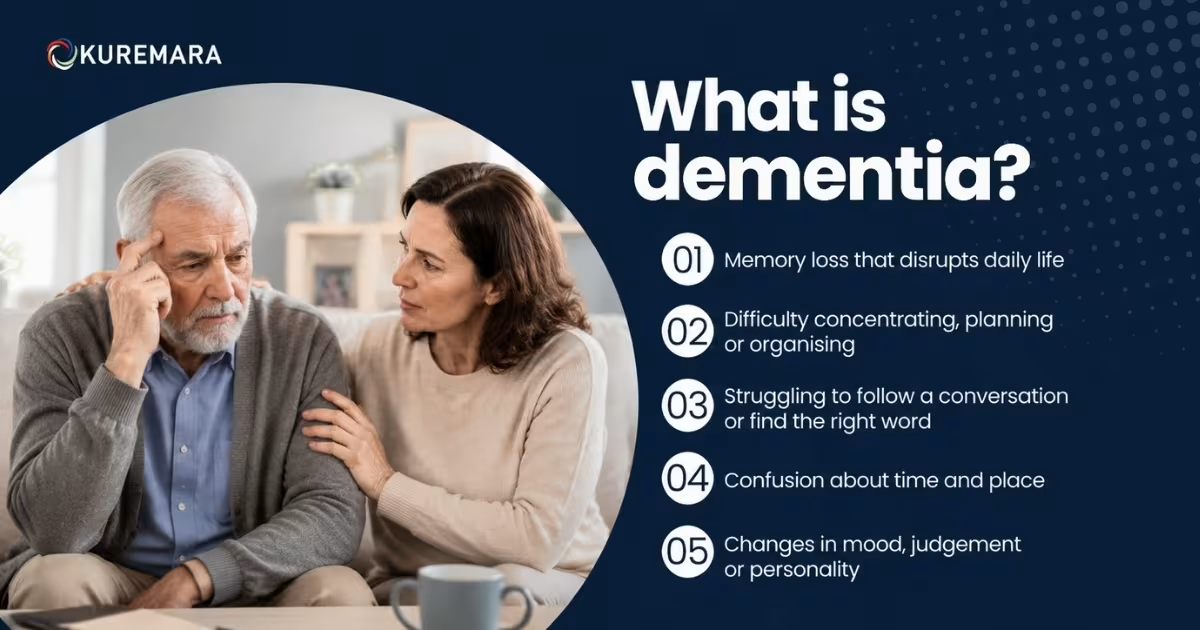
Dementia is the name for a group of symptoms associated with an ongoing decline of brain function. According to the NHS, these symptoms can include:
- Memory loss that disrupts daily life
- Difficulty concentrating, planning or organising
- Struggling to follow a conversation or find the right word
- Confusion about time and place
- Changes in mood, judgement or personality
Dementia is far more common than many families realise. Research commissioned by the Alzheimer’s Society estimates that around 982,000 people in the UK are living with dementia, a figure projected to rise to 1.4 million by 2040. Roughly one in eleven people over the age of 65 is affected, and dementia is not only a condition of later life. Approximately 70,000 people in the UK are living with young-onset dementia, which develops before the age of 65.
It’s also worth knowing that dementia is not a normal part of ageing. Occasionally misplacing your keys is ordinary forgetfulness. Regularly forgetting what the keys are for, or becoming disoriented in a place you’ve known for decades, is a sign to speak with a GP.
What is Alzheimer’s disease?
Alzheimer’s disease is a specific, progressive brain disease and the most common cause of dementia, accounting for an estimated 60–70% of all dementia cases worldwide, according to the World Health Organization.
In Alzheimer’s, abnormal proteins (known as amyloid plaques and tau tangles) gradually build up in and around brain cells, damaging the connections between them. Because this typically begins in the parts of the brain responsible for forming new memories, particularly the hippocampus, the earliest sign is often difficulty remembering recent events, while older memories stay surprisingly intact. A person may recall their wedding day vividly yet forget a conversation from an hour ago.
Alzheimer’s develops slowly, usually over several years, and symptoms broaden over time to affect language, orientation, decision-making and, eventually, everyday tasks like dressing or preparing meals.
Other causes of dementia families should know about
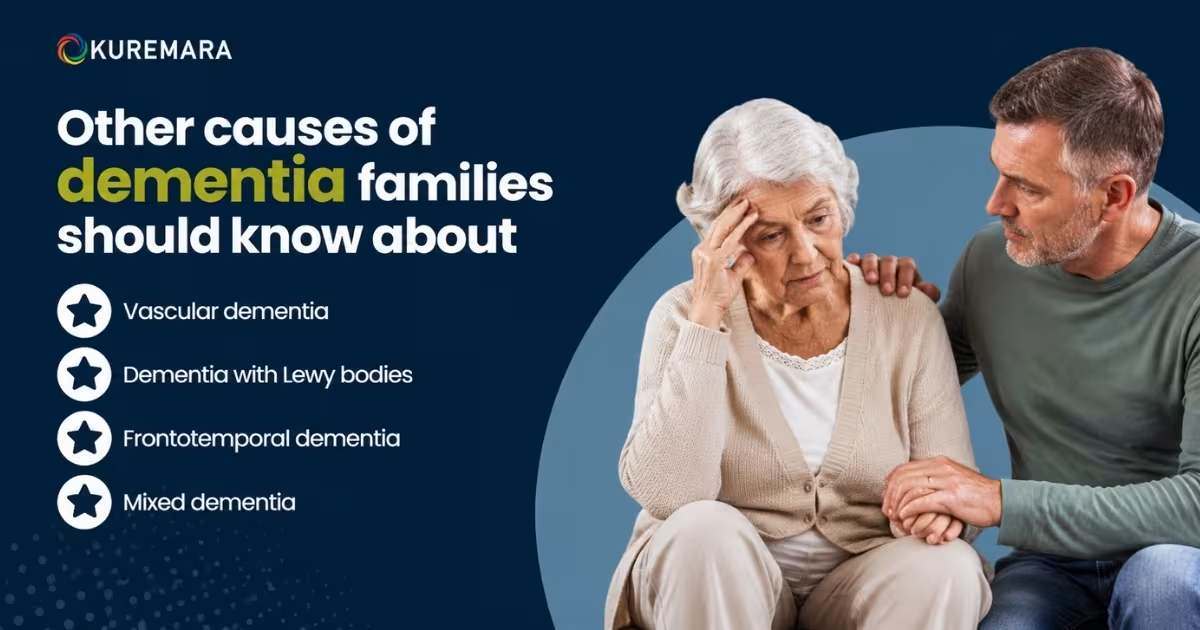
Because dementia is an umbrella, Alzheimer’s is only one of the conditions sitting beneath it. Other common types include:
- Vascular dementia — the second most common type in the UK, caused by reduced blood flow to the brain, often after a stroke or a series of small strokes. Symptoms can appear more suddenly or progress in “steps” rather than a steady decline.
- Dementia with Lewy bodies — associated with abnormal protein deposits called Lewy bodies. It can cause visual hallucinations, fluctuating alertness, and movement difficulties similar to Parkinson’s.
- Frontotemporal dementia — less common overall but a leading cause among younger people. Early changes tend to affect personality, behaviour and language more than memory.
- Mixed dementia — many people, particularly in older age, live with more than one cause at the same time, most often Alzheimer’s combined with vascular dementia.
Knowing the cause matters because different types can progress differently, respond to different treatments, and call for different approaches to day-to-day care.
Dementia vs Alzheimer’s at a glance
| Dementia | Alzheimer’s disease |
What it is | An umbrella term for a set of symptoms | A specific, progressive brain disease |
Cause | Many possible causes (Alzheimer’s, vascular disease, Lewy bodies and more) | Abnormal protein build-up damaging brain cells |
Typical early signs | Vary by cause — may involve memory, mood, behaviour or movement | Difficulty forming new memories; repeating questions; misplacing items |
Progression | Depends on the underlying cause | Gradual and steady, usually over years |
Diagnosis | Describes the symptoms | Names one underlying cause of those symptoms |
Why an early diagnosis is worth pursuing
Many families delay seeing a GP because they’re worried about what they might hear. That hesitation is completely understandable and very common. Alzheimer’s Society research suggests people live with dementia symptoms for an average of 3.5 years before receiving a diagnosis, and more than a third of people with dementia in the UK have no formal diagnosis at all.
Yet a diagnosis opens doors rather than closing them. It allows access to treatments that can help manage symptoms, NHS memory services, financial and legal planning (such as Lasting Power of Attorney), carer support, and community services. In an Alzheimer’s Society survey, over 90% of people affected by dementia said there was a benefit to getting a diagnosis.
In the UK, the pathway usually starts with a GP appointment, where simple memory and blood tests rule out treatable look-alikes such as vitamin B12 deficiency, thyroid problems, infections, depression or medication side effects. If needed, the GP refers on to a memory clinic or specialist for further assessment and, sometimes, a brain scan.
If you’ve noticed changes in yourself or someone close to you, booking a GP appointment is the single most useful next step.
How the right home support helps whatever the diagnosis
Whether the diagnosis turns out to be Alzheimer’s, vascular dementia or another type, one thing holds true across all of them: familiar surroundings, consistent faces and steady routines make an enormous difference. Research and lived experience alike show that many people with dementia remain more settled, confident and independent when supported in their own home.
That’s exactly what domiciliary care is designed for. At Kuremara, our trained care team supports families with:
- Consistent, familiar carers — the same friendly faces, because trust and recognition matter deeply in dementia care
- Personalised daily routines — support with meals, medication prompts, personal care and household tasks, shaped around the person’s own habits and preferences
- Meaningful engagement — conversation, gentle activity and companionship that support cognitive wellbeing and reduce isolation
- Respite for family carers — because looking after someone you love is rewarding, but no one should have to do it without a break
- Flexible support that adapts — from a few visits a week in the early stages through to more comprehensive care as needs change
Every person’s experience of dementia is unique, shaped by their history, culture, personality and relationships. Inclusive, person-centred care means seeing the whole person first, never just the diagnosis.
The bottom line
Dementia describes the symptoms; Alzheimer’s is the most common disease behind them. Knowing the difference helps your family ask better questions, seek a timely diagnosis, and plan care with confidence rather than fear.
And you don’t have to navigate any of it alone. If your family is thinking about support at home, whether that’s a little help each week or dedicated dementia care, our team is here to talk it through, with no pressure and no obligation.
Frequently asked questions
1. Can you have dementia without Alzheimer’s?
Yes. Alzheimer’s causes the majority of dementia cases, but vascular dementia, Lewy body dementia, frontotemporal dementia and other conditions can all cause dementia without Alzheimer’s being present.
2. Can you have Alzheimer’s without dementia?
In the early stages, yes. The brain changes of Alzheimer’s can begin years before symptoms are severe enough to be called dementia. This earlier stage is sometimes described as mild cognitive impairment (MCI), though not everyone with MCI goes on to develop dementia.
3. Is memory loss always dementia?
No. Stress, poor sleep, depression, infections, thyroid issues and some medications can all affect memory and many of these are treatable. That’s another reason a GP visit matters: it can rule things out as well as in.
4. Is dementia hereditary?
In most cases, dementia is not directly inherited. A small number of rarer forms have a stronger genetic link, but for the majority of people, age remains the biggest risk factor. Healthy habits staying active, not smoking, managing blood pressure, and keeping socially connected can help reduce risk.

References and further reading
1. NHS — About dementia: https://www.nhs.uk/conditions/dementia/about-dementia/what-is-dementia/
2. NHS — Alzheimer’s disease: https://www.nhs.uk/conditions/alzheimers-disease/
3. Alzheimer’s Society — How many people have dementia in the UK?: https://www.alzheimers.org.uk/blog/how-many-people-have-dementia-uk
4. Alzheimer’s Society — Facts for the media: https://www.alzheimers.org.uk/what-we-do/news-and-media/facts-media
5. Dementia Statistics Hub (Alzheimer’s Research UK) — Prevalence and incidence: https://dementiastatistics.org/about-dementia/prevalence-and-incidence/
6. World Health Organization — Dementia fact sheet: https://www.who.int/news-room/fact-sheets/detail/dementia
7. Dementia UK — What is dementia?: https://www.dementiauk.org/information-and-support/about-dementia/
8. Nuffield Trust — Dementia care in primary and secondary care in England: https://www.nuffieldtrust.org.uk/resource/dementia-care-in-primary-and-secondary-care-in-england
This article is for general information only and is not a substitute for professional medical advice. If you are concerned about memory changes in yourself or someone you care for, please speak to a GP.